Accessing this site
 Display settings
 Artist login

Image Description: Watershed
Linda Stupart Watershed 2020, video, 11:06
Image Description by Aubree Penney
Image Description
Clad in black galoshes, a person wades into a small, murky river, past an abandoned shopping cart that lies in the water nearby. The person’s outfit consists of pink, yellow, baby blue, and lavender tie-dyed pieces and bits of pink pastel plastic. The arraignment drips behind them, dragging the ground, covering their head like a hood in a cheerily chaotic hodgepodge of pastel bits and pieces. Bright yellow tie-dyed gloves are on their hands. Lush greenery surrounds one side of the river, with tangles of roots emerging near the waterline.
They walk away from the camera towards a brick bridge with two arches, circles of water rippling out from their feet with each step.
Splashes of water accompany each of the figure’s steps, as the chitterings of birds mix with the rush of passing traffic and the light whisper of wind.
A warm, welcoming voice off-screen layers over the background noises of the river:
Ok, so, everyone close your eyes. Ok. So, now that your eyes are closed I want you to really think about the spit that’s in your mouth. So like everyone has spit in their mouth. Just be really aware of that spit in your mouth.
Ok, so you’ve got the spit, it’s there, it’s in your mouth. Now what I want you to do is imagine that there’s a cup in front of you. You’ve got a cup, it’s empty, maybe it has some water in it. It’s in front of you. Now, I want you to think and imagine spitting that spit out into the cup in front of you. Ok. Cool. Now that you’ve done that, I want you to pick that cup up and drink that spit back into your mouth again.
The camera dips into the water, revealing a tumult of sticks and dirt, decomposing leaves, and a white strand.
The camera shifts angles, revealing the figure emerging from beneath the brick bridge. A stone wall with trails of ivy meets the bridge at its top, containing the river, with a wealth of greenery emerging from the damp land at the river’s far edge, piles of stones and debris on the bank nearest the camera. The river narrows to only a few meters’ wide.
On screen text beneath the figure reads: The long arm of the law was in full evidence when police were called to reports of a human limb floating in a Birmingham river.
Splashes accompany the slow, steady movement of the figure in the water as the birds continue to sing.
On screen text beneath the figure reads: And the officers went further out on a limb after they struggled to get out of the river – providing amusement to those watching the operation to retrieve the wayward body part.
The voice off-screen clears its throat, which echoes slightly, before beginning to sing Black Sabbath’s “Electric Funeral.” The pace is slow, lingering, sung in a rich middle range and lending a haunting air. The song clings to your skin, subtle but insistent. The sounds of the riverbank continue in the background, the twittering of birds lightly piercing the darkness of the sung melody.
The voice sings:
Ba, ba da nuh nuh, duh nuh nuh, duh nuh nuh, ba ba
The gurgling of the river replaces the sound of birds as the camera dips into the water.
The camera plunges and twists beneath the water, revealing dirt and detritus in the grayish water and offering momentary glimpses of the figure’s pastel robes, stirring bubbles beneath the water and a blue sky above streaked with white clouds.
Our view shifts back to the figure, slowly proceeding along the river. A black and white image of an arm layers over the left side of the image. The arm is wrapped in something at the elbow, the skin looking mottled and patchy. The hand is outlined in yellow, raising it against the screen. Behind the picture of the hand is a vertical video hovering over a container of orange goop with bits pressed into it. The video of the orange goop disappears. In the center, beneath the black and white hand appears the image of a blue-gloved hand holding a white, stuffed glove with blood on its fingertips in front of a river with rocky banks and lots of trees around it.
The figure approaches a small waterfall.
The camera shifts to the top of the waterfall. The black-and-white hand image disappears, shortly followed by the disappearance of the image with the stuffed glove.
The figure clambers over the falls and stands at the top, revealing in their hand a Y-shaped wooden diving rod, with orange string and a small camera at the top. A tattoo peeks out just beneath their right elbow.
The voice continues to sing:
Reflex in the sky-y warn you you’re gonna di-ie
Storm coming, you better hi-ide from the atomic ti-ide
Flashes in the sky-y turns houses into sti-ies
Turns people into cla-ay, radiation mines deca-ayyy
The voice emulates a guitar interlude, the sound becoming increasingly sharper and more insistent:
Dee da na now, de duh na now, do do duh na now, dee dee nuh nee, duh duh da now, dee dee nuh nee,
Bow bow buh na now, duh nuh nee
Robot minds of robot sla-aves
Lead them to atomic ra-age
Plastic flowers, melting sun
Fading moon falls apart
Dying world of radiation
Victims of mad frustration
Burning global oxy’n fire
Like electric funeral pyre
The figure continues their journey, the waterfall now behind them. They reach down and grab a long, thin branch, untangling it from their clothes. They toss it behind them, the branch eliciting a small spray as it smacks the water.
A light splash joins the sound of the figure wading as they throw the stick in the water.
Duh da na now, de nuh na nee, ba ba da nuh, dee nuh na nee
Ba bow duh na now, nuh nuh na
The figure progresses between two piles of sticks in the river, speckled with castoff bottles and other pieces of rubbish.
The voice transitions to the rhythmic, airy flicking sound of a tongue flicking the top teeth, steady as the second hand on a clock. The rhythm continues, now comprised of gentle, insistent tapping sounds that have the steady rhythm and assuredness of a warm rain on skin.
The camera dips beneath the water, revealing murkiness and the pinks of the figure’s robes once more as well as the verdant edges of the bank.
As the camera dips under, the gurgling rushes of the river return.
An inset box, framed now by murkiness, reveals the figure navigating under and around a low canopy of branches that are over the river. A fingertip briefly slips in front of the camera lens.
The high-pitched bird songs return as the tapping fades.
The background image shifts to the figure wading towards the camera. In the foregrounded image, the figure trips on a branch and slowly falls into the water. They slowly sit up and begin to remove their mask.
A deep, startled exhale as a branch snaps, followed by a slow splash.
The airy rhythm returns, a ticking made of breath, tongue, and teeth, quickly switching to the drumming of flesh against a surface. The drumming grows louder, softens, and then abruptly halts.
The image cuts to a skinned knee with blood dripping down, leaving rust colored trails behind on the pink skin, the damp pink, yellow, and light blue fabric hanging about the hurt leg. The camera twists, revealing a tattoo beneath the skinned knee, now black lines merging with light pink streaks of blood as the blood drips past the tattoo and down into the rainboot.
A soft voice, the slight kiss of breeze brushing past is audible around them:
Thank you
All sound ceases.
The camera pauses on the figure’s head, covered in a gray and pink floral mask with huge half-sphere eye pieces of clear plastic. Bits of lavender and laminated fronds are revealed to be part of the ensemble. The figure’s right hand wears a yellow tie-dyed glove and holds the diving rod aloft. Bits of orange yellow, white, and pink string adorn it, mixing with wires and buttons for technology and a laminated paper that reads “Deriving from the Latin word vulnus [wound], vulnerability expresses the capacity to be wounded and suffer. As bodily, social, and affective beings, we all have the capacity to be vulnerable to one another and to conditions of inequality, discrimination, exploitation, or violence, as well to the natural environment. The next sentence is crossed out.
The sloshes of the water and bird songs return.
The figure proceeds onward down the dirt bank beneath an organically formed archway of trees and bushes. Tiny, lacy white flowers dot the ground to either side of the dirt path.
The off-camera voice speaks:
Scum on the top of the river, skin on the top of milk, skin on the top of the river, scum on the top of milk. The River Cole is constantly threatening to flood like I am, like we are.
[a deep breath]
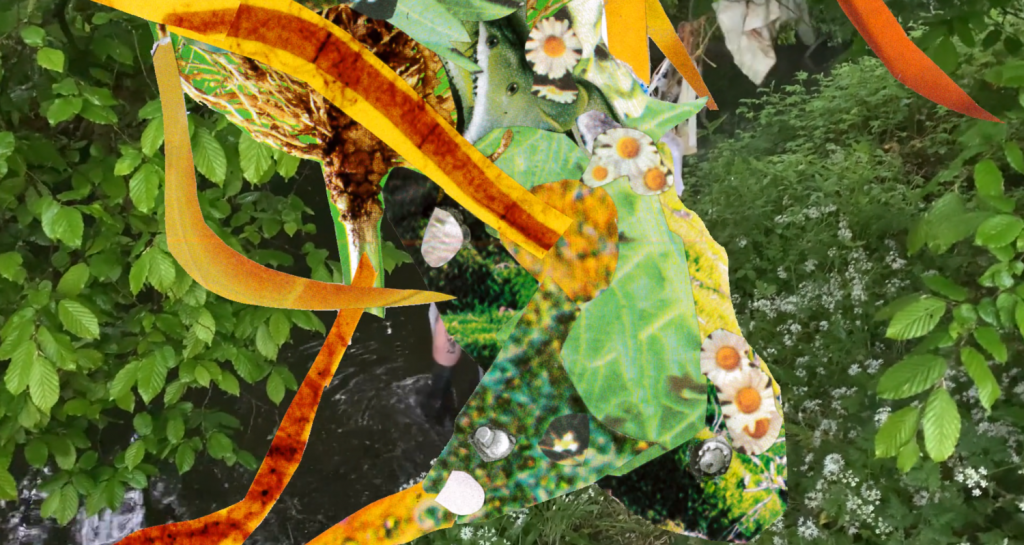
Superimposed on the screen is a collaged tangle of daisies, leaves, yellow and green slivers, a cacophony of soft angles and cheery natural hues. Behind the collage, the figure steps back into the river and proceeds on their journey, greenery visible on both sides of the water.
The limb, the Cole’s River limbs flailing upstream towards her mouth and her teeth. When you drink a glass of water you also drink its ghosts. When you piss in the mouth of the river, your wastes embrace her pasts.
The image of the blue-gloved hand holding the stuffed white-gloved hand in front of the river is superimposed over the collage.
Do keep body movements minimal. Do move and gesture slowly and naturally.
The superimposed images disappear, giving a clear view of the figure wading in the river, their divining rod in their right hand.
Do maintain eye contact by looking straight in the camera.
The collage of leaves and daisies and ephemera and the image of the blue-gloved hand holding the stuffed white glove in front of the river are superimposed over the figure’s journey again.
Bodies and the law are diametrically opposed. And the power of the police and/or men comes from somewhere else from flesh or bone or viscera, rather from unwoundedness, calcifications, non-porous materials.
The collage disappears. The superimposed image of the stuffed white glove shifts to a video showing reflection on the water’s surface and then scum at the bottom of the river, a glimpse of the divining rod, then more brown debris and dirt beneath the water.
The virus sits on these materials but does not penetrate them. Rather, she waits. Scum on the top of the river, skin on the top of milk, as the river flows, it picks up sediment from the riverbed, eroding banks and debris in the water. The river mouth is where much of this gravel, sand, silt, and clay is deposited.
The superimposed video disappears, leaving only the figure in the river.
The haunting song interjects:
Turns people into cla-ay.
On-screen text at the top of the page, in white text atop an image of river water: the police hate water because it does not obey the law
Immediately the singer transitions back to speech:
The police hate water because it does not obey the law and because they cannot swallow or incorporate her.
The on-screen text disappears. A black and white image of a right hand, marked with red bits and globs of ooze, a bit of red flakiness at the center, appears in the bottom right corner. The hand is surrounded by a thick yellow line.
Kill the cop in your head to lose your tongue and exit language, swim in the blue lagoon now dyed black, let algae stick to you and stop holding hands.
The image of the oozing hand disappears. The figure has almost reached the limits of visibility for the camera and glances back quickly, then proceeds onward.
Cling to the viscera in your head, kill the cop in your high-wage, high-skill, high-productivity economy.
The Prime Minister says he does not care if you die, but that is because he does not understand that the dead are still a threat to him and to the law. When you drink a glass of water you also drink its ghosts. When you piss in the mouth of a river you also come in her pasts.
A path of spaced stones spans from one bank to the other, forming a walking path. A huge, decaying log sits to the right. Water flows between each stone, forming tiny waterfalls as the water changes levels by a few feet. The camera gets closer and closer, revealing moss on the stones of the path and the foam at the bottom of the miniature waterfalls, and begins to cross the river.
The water rushes in the background, a gentle but ceaseless torrent of sound.
The haunting song interjects, gaining speed and urgency:
Rivers turn to mud, eyes melt into blood
A wobbling clip of tan eggshells on the dark riverbed is superimposed atop the pathway of stone and waterfalls.
The mouth of my mouth and the spit of the river.
The camera swivels at the center of the river, revealing the figure slowly proceeding towards us, flanked on either side by tall trees and lush tangles of small white flowers. Birds dart across the river, making ripples as they touch down, and a huge limb lies in the midst of the water.
I am meters away from you and in the river holding my breath and still sucking up your sediments discharging foam and teeth.
The video of the bloody knee, surrounded by pastel swaths of the figure’s attire, is superimposed atop the river scene, framing the knee with greenery and rippling waters.
Foam on the water, sign of life and death.
The virus and the river water slither down policemen’s teeth or cheek, resides there. The mouth becomes the source, becomes the rapid and the edge.
The superimposed image disappears.
You find the bones of children sometimes, soft hands on necks or weeds tangled between toes and mud and stinking flesh. Amniotic fluid often spills before it breaks, and sometimes fishes also die, she said, as eggs come tumbling onto scales and gills and mammalian hair on legs.
A video of the figure kneeling in the water, holding their masked head with their left hand and dipping their divining rod into the river with their right. A white stuffed glove is visible next to the rod. The figure slowly moves the rod in the river, its strands of fabric and ephemera floating, shifting with the motion of the rod and the current.
Eggs are always a disaster or a triumph, like the river and your viscera, or the virus and the sea.
The superimposed image disappears. The figure uses the rod for stability as they continue towards us, navigating around the branch in the midst of water.
Do keep minimal straight body naturally across the path to keep the other and the virus safely out and maintain body and maintain eye appeal to the warm contact camera contact nature keep slowly looking straight into the body.
The haunting singing emerges from the background, so soft as to be nearly indecipherable. It hovers in the back of the mind of the video. It sings:
And so in the sky shines the electric eye
Supernatural king takes earth under his wi-ing
The speaking voice off camera continues, edges of phrases and sentences blurring and piling upon each other in a near breathless torrent of words:
There caught in the elbows of fallen trees are curving mounds of white foam. Police are called about a water in the body and a body in the water or the river found dead across the edge or bursting skin cells multiplicities and masks and balls at the end of your arms at the end of the ball at the end of nothing. Rehabilitation of the riverbanks are getting better, but what if we never get better or go freckles forward, but what if we never get better or go forward but circle around rather in and out.
The water grows deeper as the figure nears the camera. The figure’s steps become more tenuous, deliberate as the water reaches their thighs. They sink down with the divining rod, the water level up to their chest.
The volume of the song in the background swells. It progresses still at a slow, haunting pace, but feels bolder, more confident, less content to linger:
Heaven’s gold chorus sings
Hell’s flap their wi-ings
Evil souls fall to hell
And they’re trapped in burning cell
Da na now, da da na now. Doo duh da na now, da na na now. Da na now, da na na. Duh nuh nuh, Buh buh na na,
The figure leans back, immersing themselves entirely. The screen goes black.
The sound of rushing water in the background abruptly ceases, leaving only the singing voice to continue with its interpretations of Black Sabbath’s guitar.
A white text box appears on the black screen. It reads:
PART 1
Shot on location in the River Cole (Sparkhill – Hall Green)
Filming by Tom Dillon
Song by Black Sabbath
A beat picks up, both in time to the rhythm of the syllables being sung, recalcitrantly deviating at others.
Doo doo do-do, doo doo do-o
Buh buh buh, buh buh-a
Buh buh na na
Duh Duh duh now
Buh buh buh, buh buh-a
The white textbox disappears, leaving only a black screen.
The beat increases in speed, becoming a frantic heartbeat for a few seconds before disappearing entirely.
The song continues softly:
Buh-a. Duh na. Duh na.
Barely audibly, the voice concludes, still on pitch and beat with its song, leaving us with a gentle, hovering syllable:
Mmm