ON FAILURE

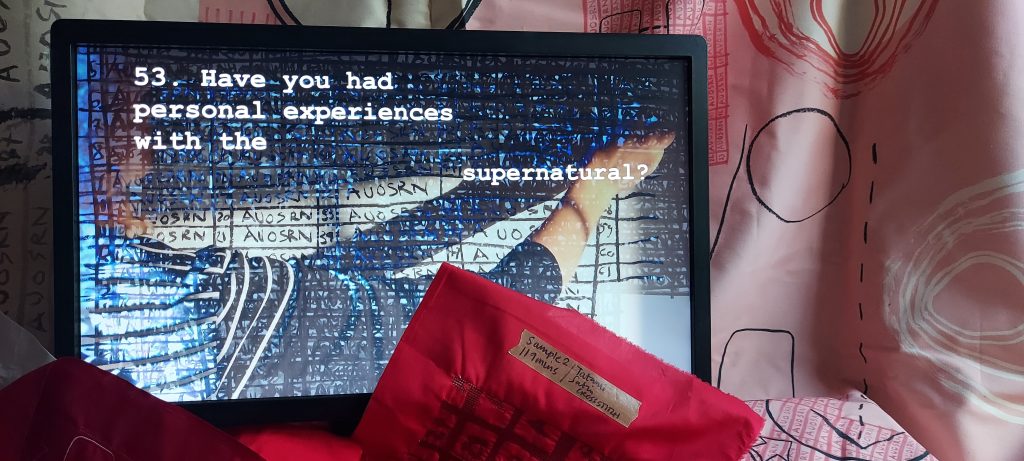
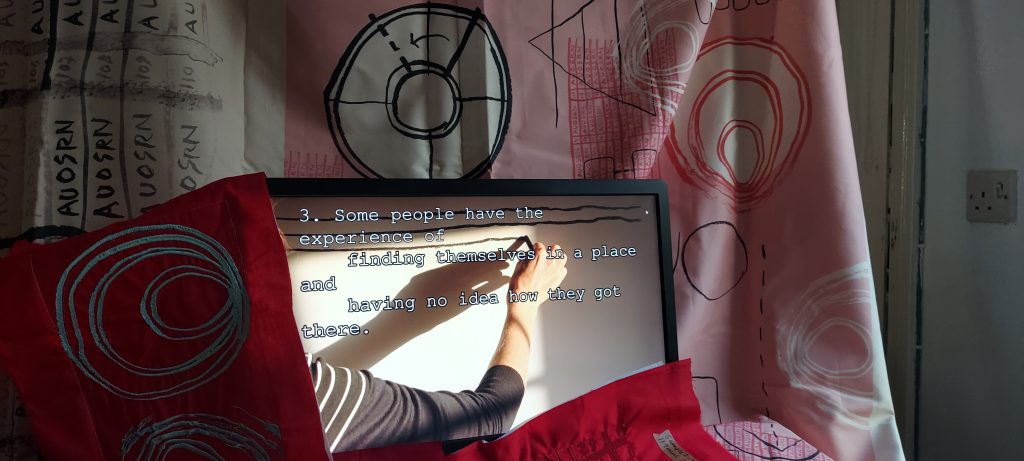
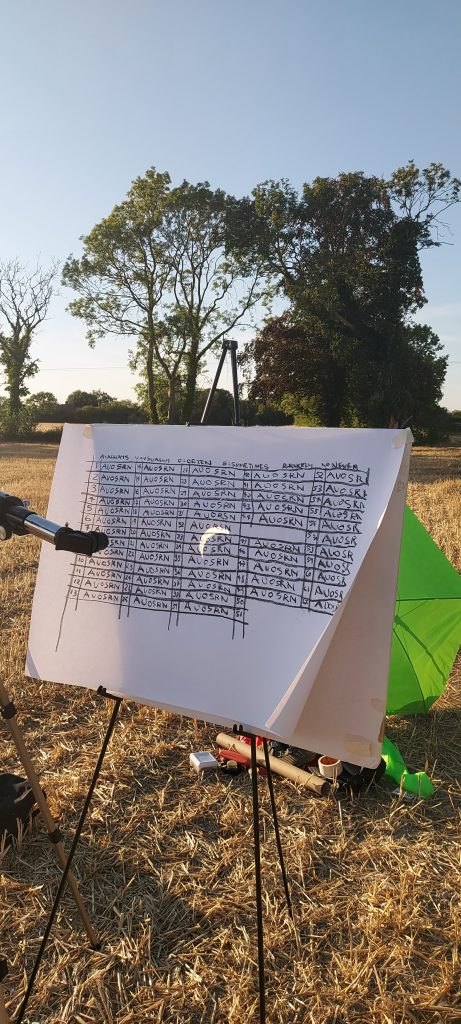
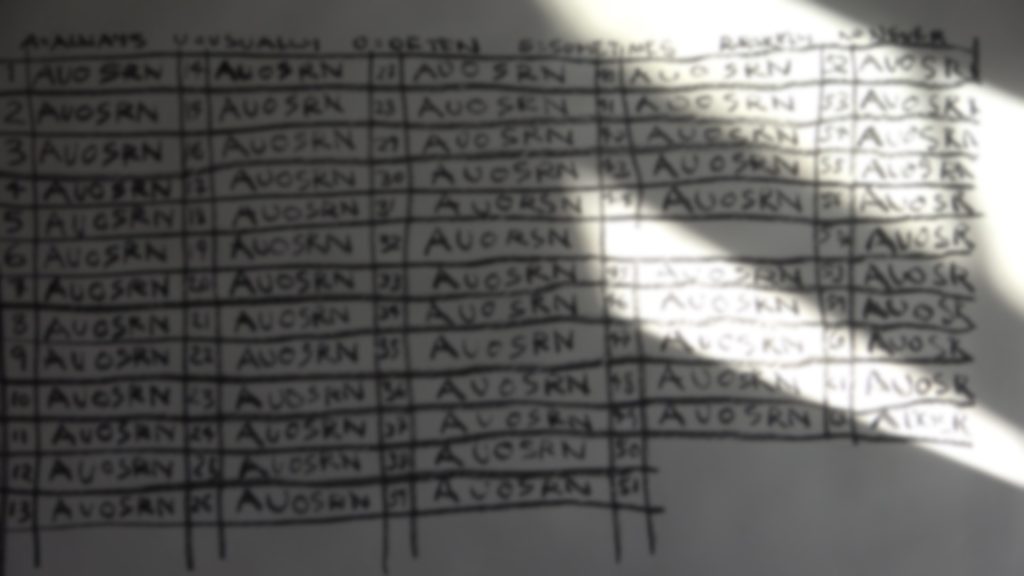
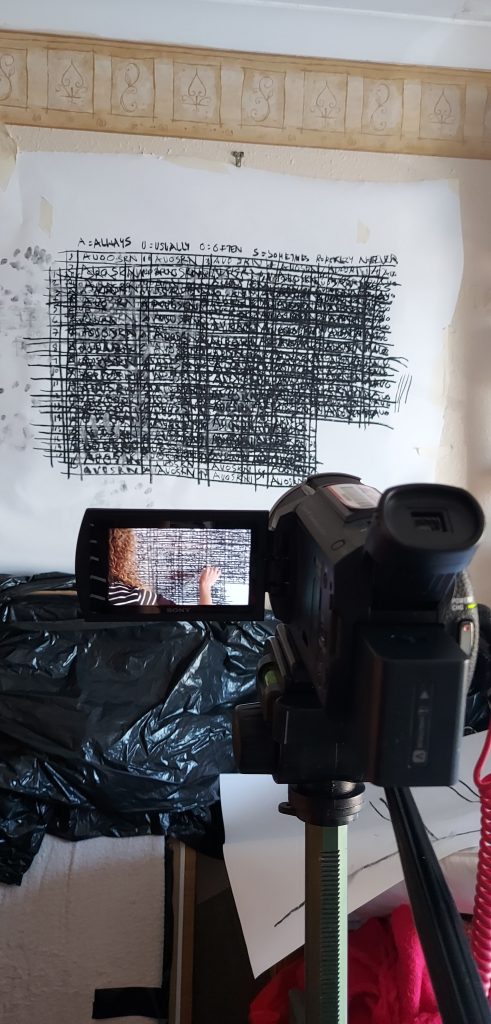
Last week I experimented with filming myself drawing and redrawing the assessment chart. I tried to film in morning light as a way of bringing together two types of time and a link to ecologies (with a nod to Carolyn Lazard and Jade Montserrat). BUT I keep failing, I am not a film maker and the filming is out of focus, is too dark, doesn’t fit in the frame, stops before the end, also, because I am tired, I get up too late for the sun, my body aches from drawing this way and I have to stop repeatedly. It is incredibly frustrating but then I realise this is the process. This is the ridicularity and failure I am trying to embrace. And the rub against normative aesthetic, even architectural, desires to make it neat and tidy is palpable.

A blurry image of a chart of lines, numbers and letters drawn in black on a white background. Most of the image is in shadow with some patches of sunlight on the right which are white and tinged with yellow. The chart is composed of numbers that run from 1 to 62 and repeated letters AUOSRN. At the top there is some indistinguishable writing that appears to be a legend for the chart.
The image shows a video camera on a tripod pointing at a wall. Taped to the wall with masking tape is a large piece of paper. It has ripped edges and looks as if it was cut in a hurry. The wall behind is papered in woodchip wallpaper and painted with magnolia paint, the kind you find in a domestic bedroom, and the top of the wall has a faded decorative wallpaper border with repeating motifs. The paper contains a hand-drawn chart or grid filled with handwritten text and heavy black lines written in deep black charcoal, making much of the content obscured. Across the top are handwritten notes defining letters, including 'A = always, U = usually,' 'O = often,' 'S = sometimes,' and 'R = rarely.' The camera’s fold-out screen displays a close-up view of a hand drawing on the grid. Black plastic sheets cover furniture or stored items beneath the wall.
The image shows a video camera on a tripod pointing at a wall. Taped to the wall with masking tape is a large piece of paper. It has ripped edges and looks as if it was cut in a hurry. The wall behind is papered in woodchip wallpaper and painted with magnolia paint, the kind you find in a domestic bedroom, and the top of the wall has a faded decorative wallpaper border with repeating motifs. The paper contains a hand-drawn chart or grid filled with handwritten text and heavy black lines written in deep black charcoal, making much of the content obscured. Across the top are handwritten notes defining letters, including ‘A = always, U = usually,’ ‘O = often,’ ‘S = sometimes,’ and ‘R = rarely.’ The camera’s fold-out screen displays a close-up view of a hand drawing on the grid. Black plastic sheets cover furniture or stored items beneath the wall.

LOOSE GRIP

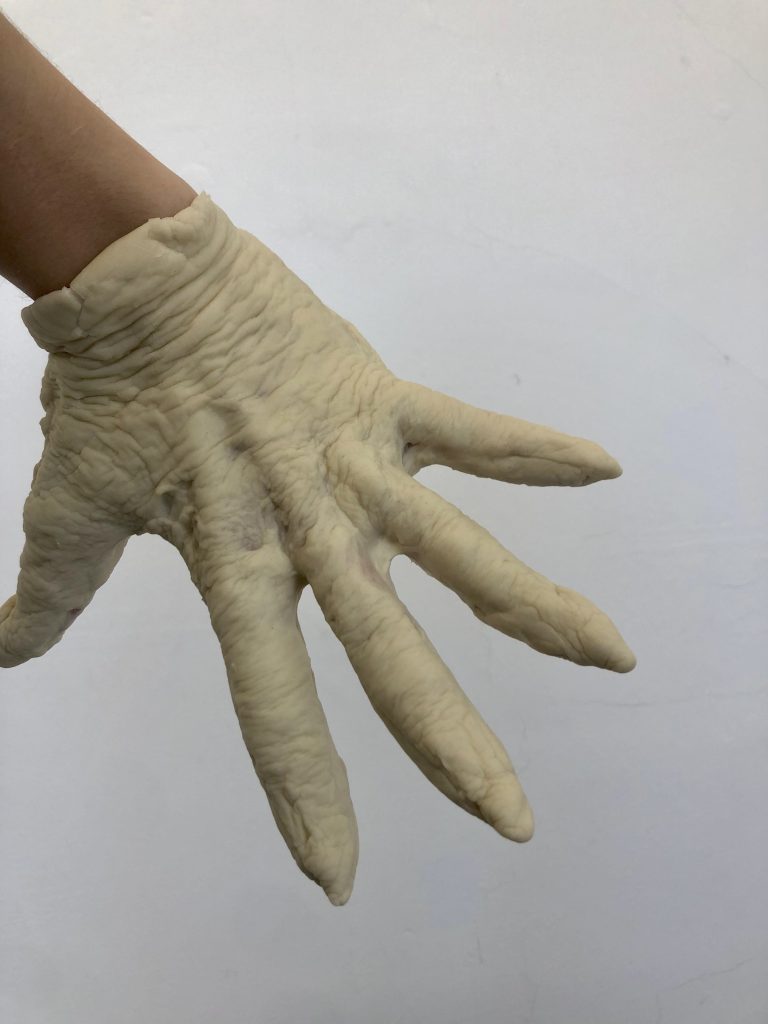
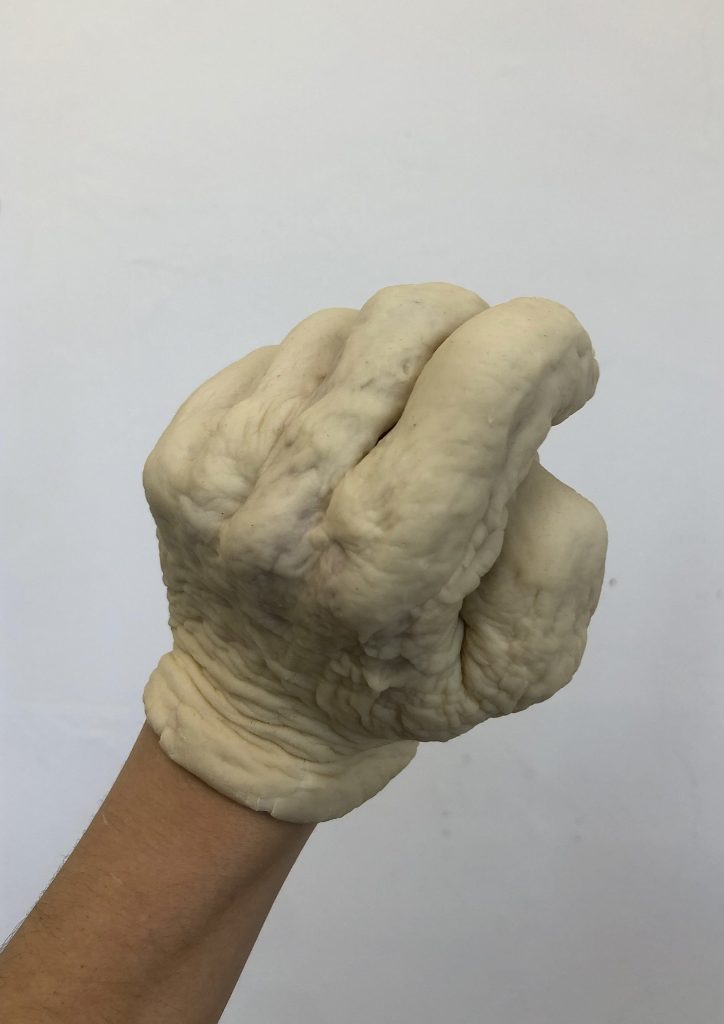
The last post of gathered images reminded me of when I encased my hands in dough for a test shoot for a short film.

ALWAYS USUALLY OFTEN SOMETIMES RARELY NEVER

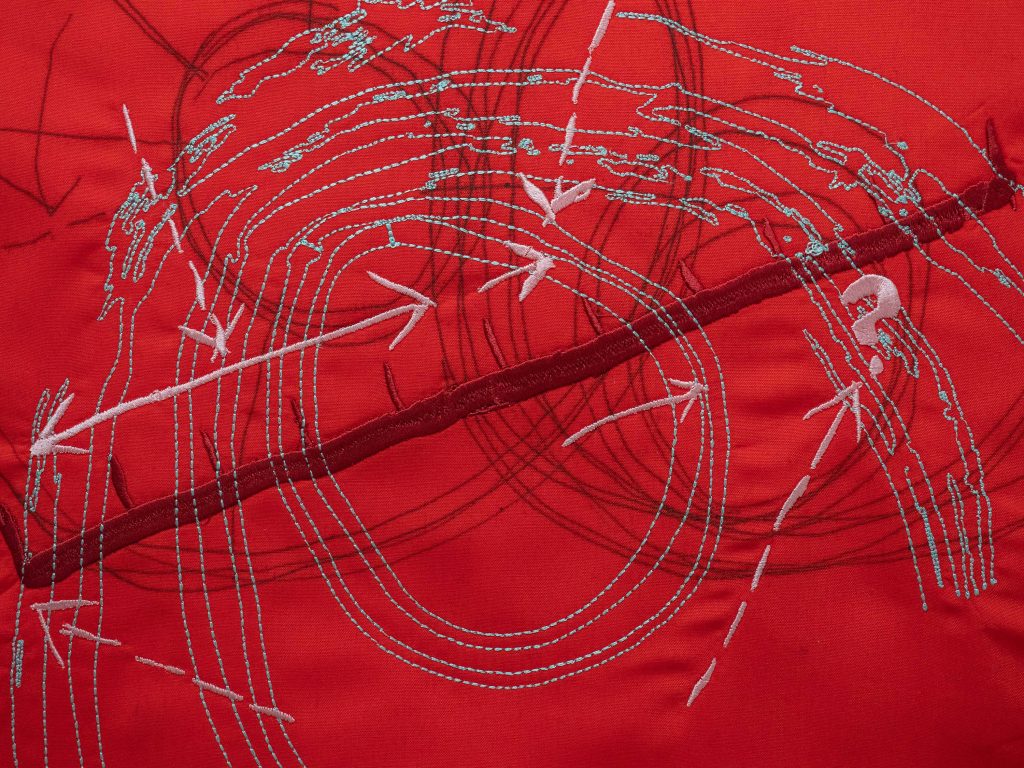
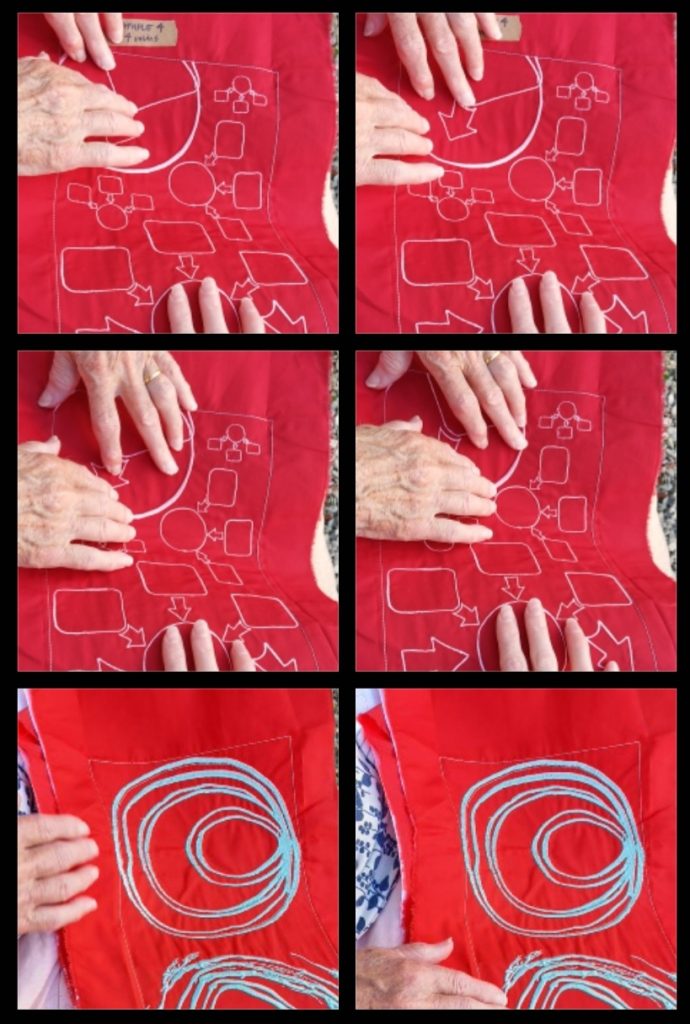
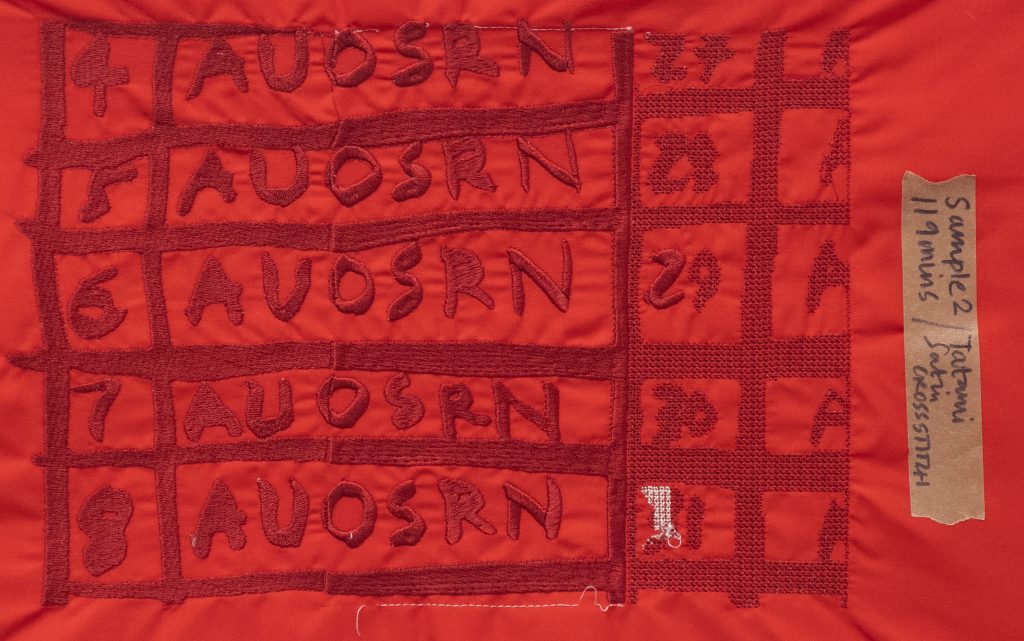
A photograph of deep dark red digital embroidery stitched onto a paler blood red fabric. The embroidery is in the form of a grid with numbers that run from top to bottom 4-8 and 27-31 consequentially and letters that read AUOSRN. The chart is cut off and in places the letters A are cut in half and in others red stitching is over sewn in white. On the right hand side a piece of brown tape with ripped edges has been stuck on the fabric. on the tape hand written text in black felt tip pen reads: Sample 2 119 mins / Tatami Satin CROSSSTITCH.
A photograph of deep dark red digital embroidery stitched onto a paler blood red fabric. Numbers run from top to bottom 4-8 and 27-31 and letters read AUOSRN. On the right hand side is a piece of brown tape with ripped edges stuck to the fabric. On the tape hand written text in black felt tip pen reads: Sample 2 119 mins / Tatami Satin CROSSSTITCH. Image: Josie Turnbull

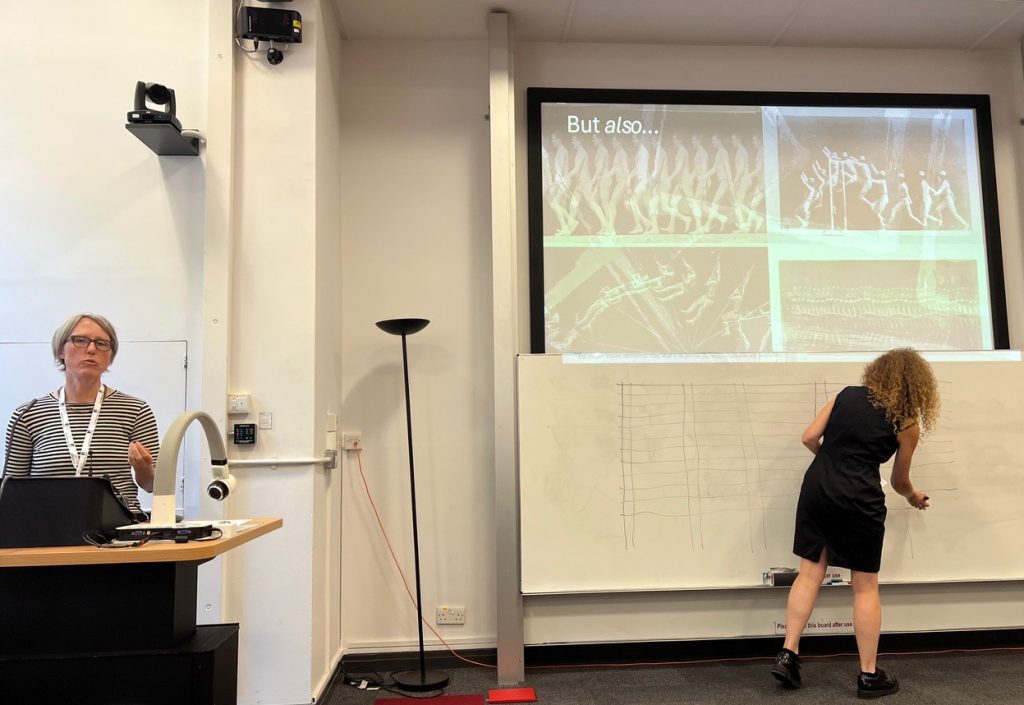
I’ve been redrawing this mental health assessment chart for a while now. I have drawn it in charcoal, in watercolour, in ink, on fabric and translated it into digital embroidery. I am excited to explore where the material of the chart breaks down and fails, but also the performance-based repetitive action of filling in nonsensical questionnaires as an embodiment of crip time. I drew it recently on a whiteboard as part of a performative lecture at a the Society of Social History of Medicine conference at Leeds University with my co-conspirator 20th century healthcare historian Dr Caitjan Gainty. As I drew Caitjan talked about the histories of efficiency and productivity in spaces of work, medicine and healthcare…

The photograph shows a view of the front of a typical lecture theatre or classroom. On the right a projection screen displays 19th-century motion-study photography and chronophotography illustrating human locomotion phases of upright male figures, notably featuring works by Eadweard Muybridge and Étienne-Jules Marey. These were the foundation of 'time and motion' studies by which awkward or redundant movements could be eliminated, tool layouts redesigns, fatigue reduced, and factory assembly-line efficiency maximised. 
Beneath the projected image is a whiteboard. A pale skinned woman in a black sleeveless knee height dress with red curly hair is drawing a chart on the whiteboard. She is leaning, a little awkwardly, to the right in order to bend to reach the extent of the board. On the left is a desk with a visualiser and lectern. A pale skinned grey haired woman with black rimmed glasses and a lanyard is speaking and making hand gestures to an invisible audience in front of the desk.
Caitjan Gainty (left) and Helen Stratford (right) presenting ‘The Ins and Outs of Productivity’
at SSHM 2026: In/Out University of Leeds July 2026: 20 minute paper and live drawing presentation.
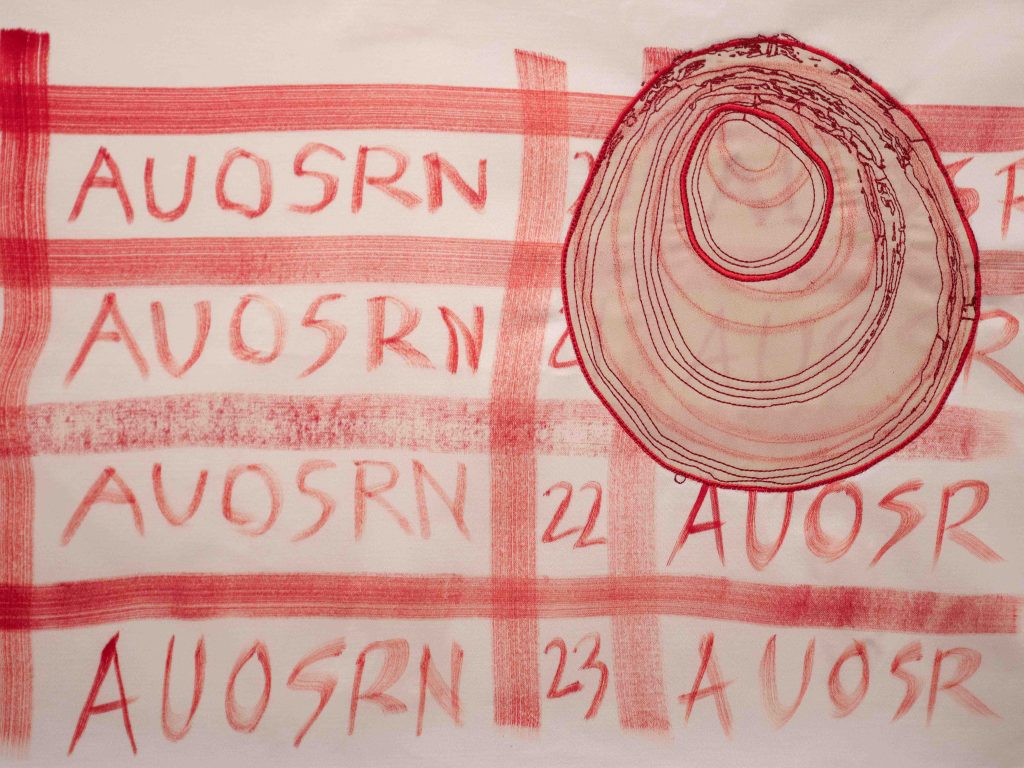
The image shows a grid drawn in bright blood red ink on pale cream silky fabric. The brush strokes from a wide stiff brush can be clearly seen in the lines of the grid. Inside the grid are letters and numbers drawn in a thinner brush that read AUOSRN and the numbers 22 and 23. On the top right hand side the grid is overlaid with an appliqué addition made from a darker cream translucent fabric. This has smudgy monoprint drawn and precisely stitched concentric circles in bright and deep red which break down and unravel at the top. It looks like an oyster or a finger print.
A grid drawn in bright blood red ink on pale cream silky fabric with numbers 22, 23 and letters: AUOSRN. On the top right hand side the grid is overlaid with an appliqué addition with monoprint drawn and precisely stitched concentric circles in bright and deep red which break down and unravel at the top.
The stitch time for the appliqué was around 22 minutes. Image: Josie Turnbull.

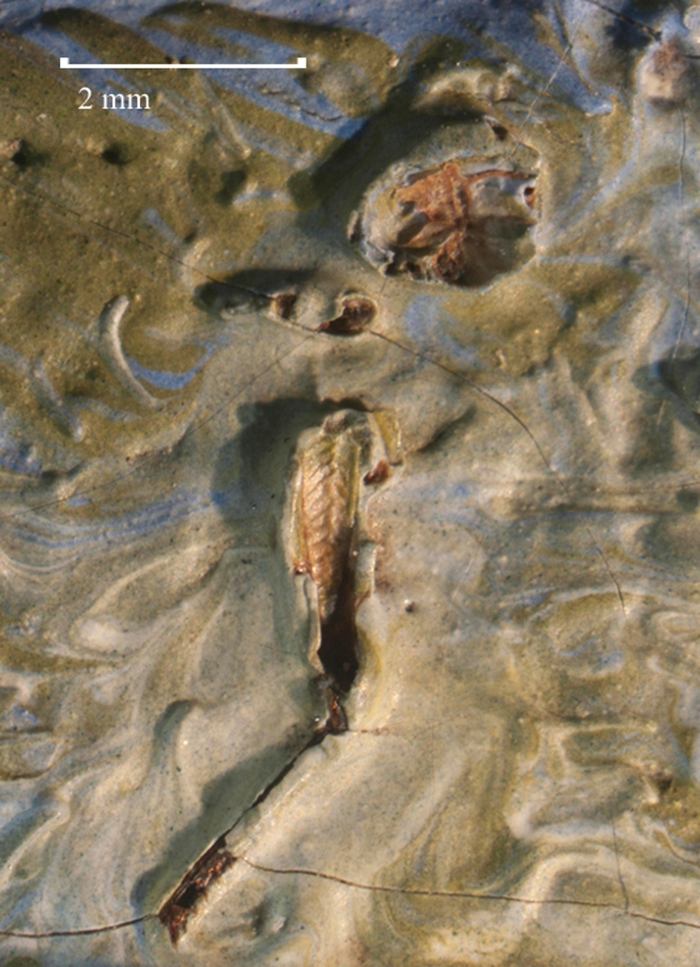
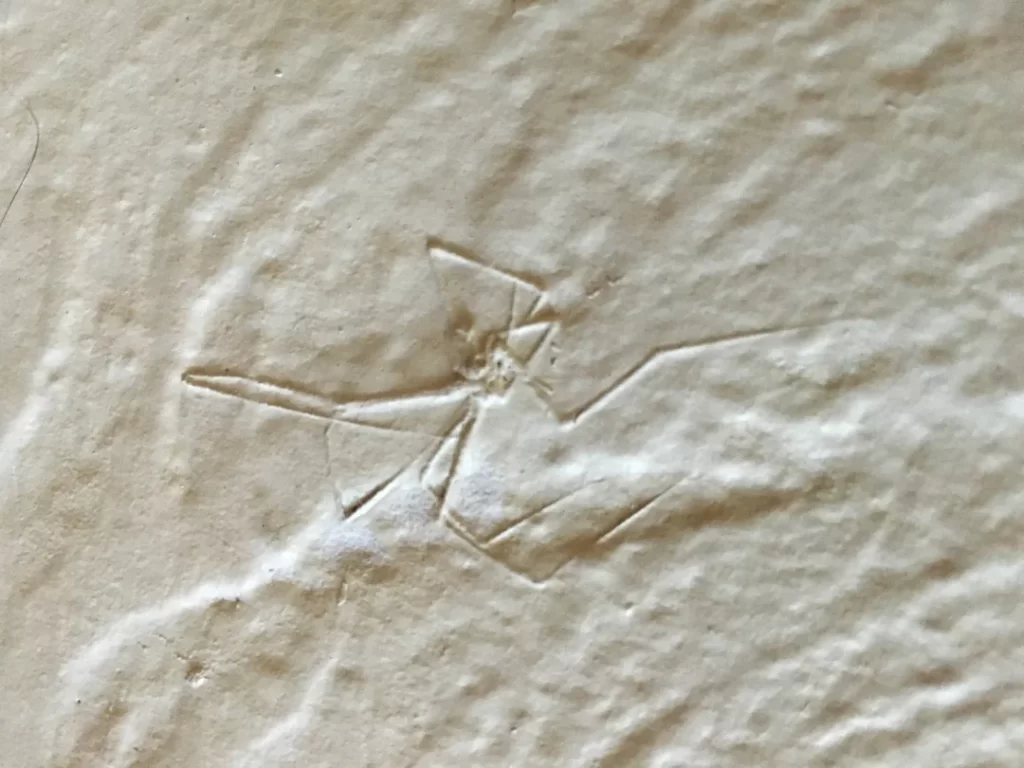
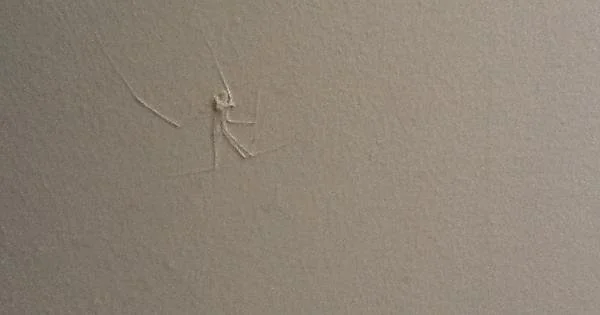
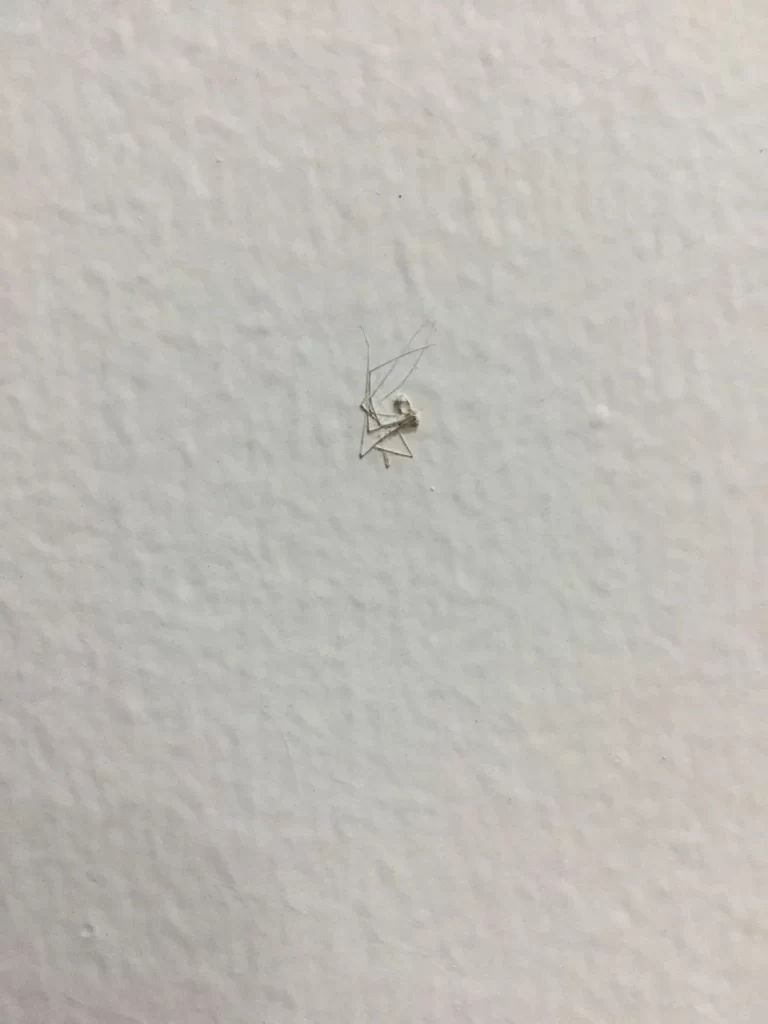
MUMMIFIED ROOMMATE

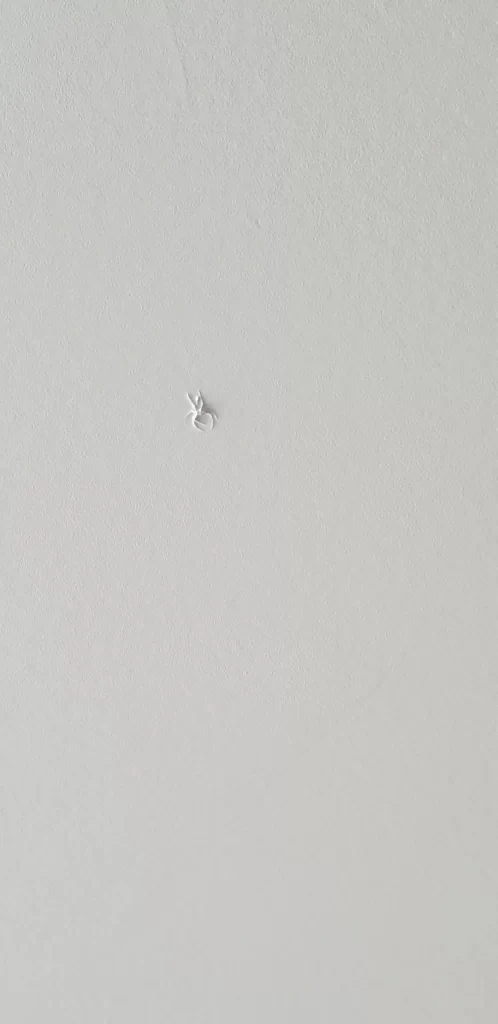
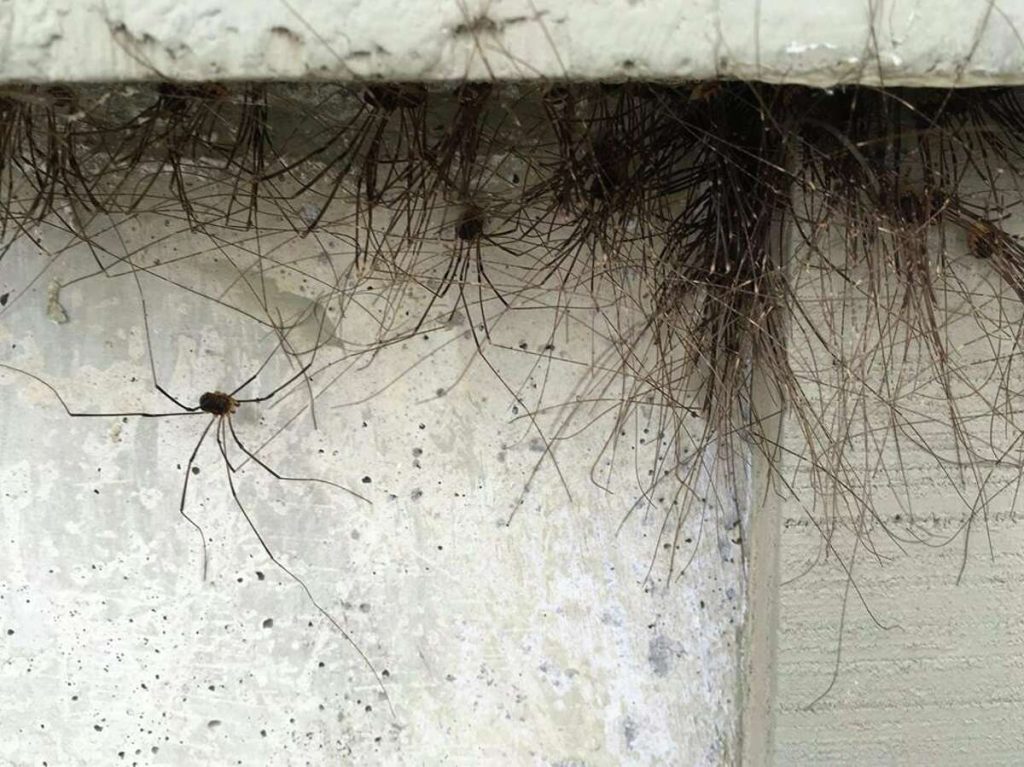
1. MetalKingFlandango, r/NotMyJob/, Reddit, Guys who painted my shop just straight up painted over this spider. 5y ago. Access Online.

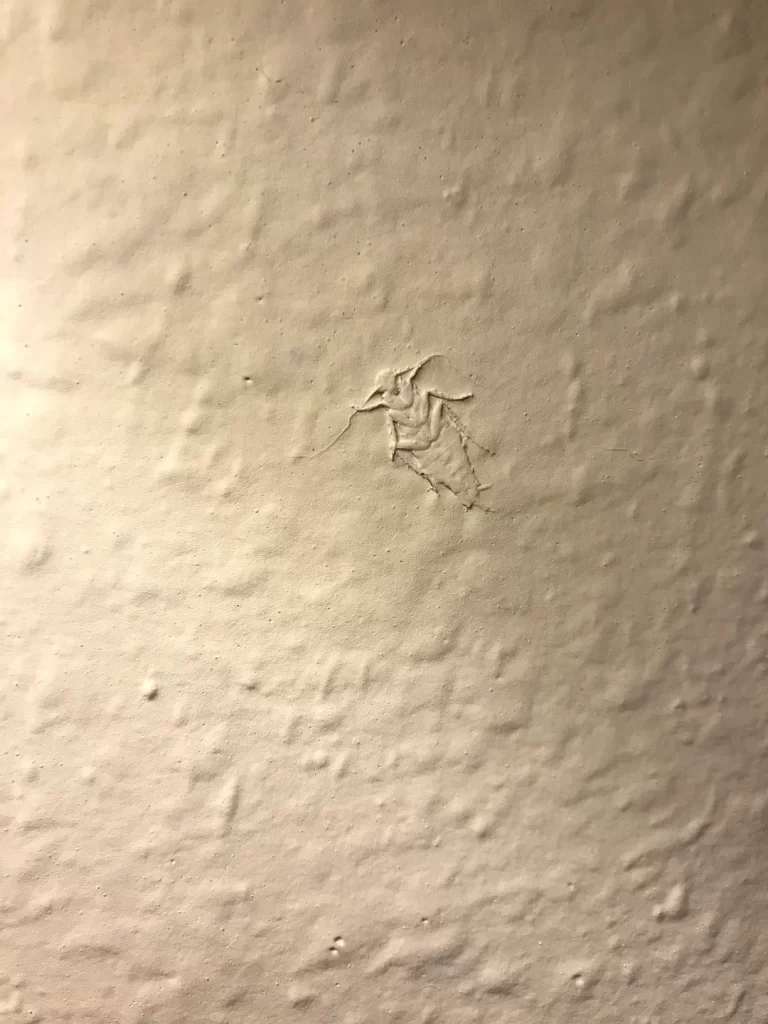
2. Palafitteposide, r/mildlyinteresting/, Reddit, This bug I found painted over on my wall today., 7y ago. Access Online.

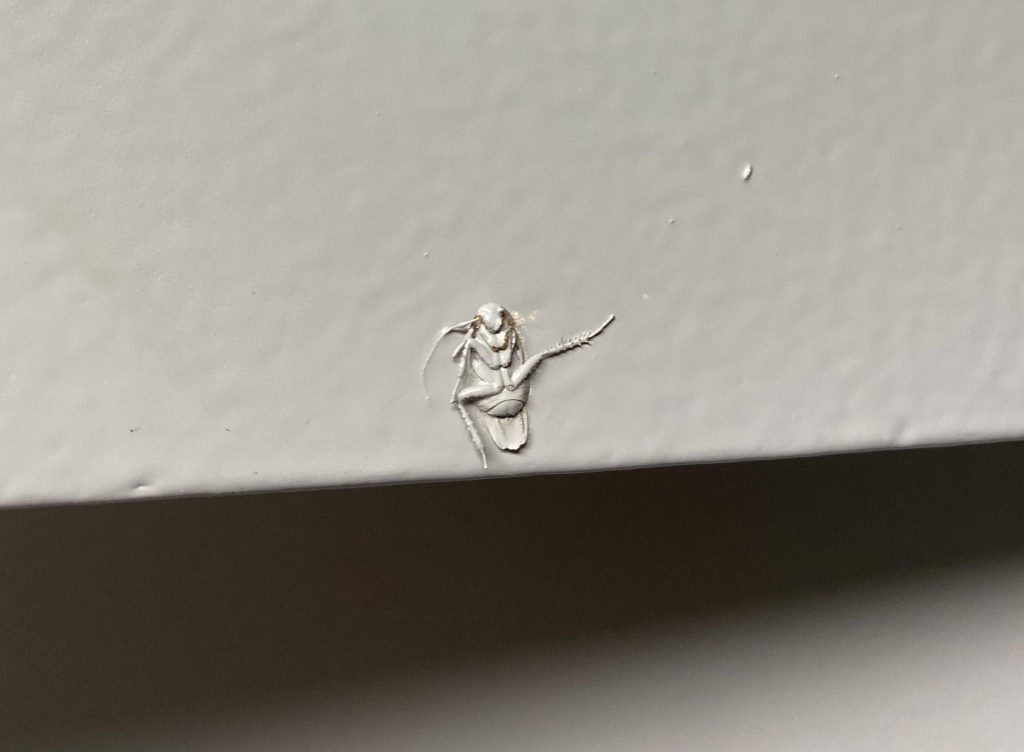
3. chelsea, a human woman? @chellzyeah, Twitter, My landlord painted over a fucking roach, 11:39PM Sep 4, 2021. Access Online: Carly Stern, Daily Mail, Texas woman reveals her landlord painted over a COCKROACH on her wall as she shares a hilarious image of her ‘mummified roommate’ – sparking a wave of memes and jokes on Twitter, 8th September 2021.

4. Vincent van Gogh, detail of Olive Trees. Access Online: Mark Brown, Guardian, Dead grasshopper discovered in Vincent van Gogh painting, Wed 8 Nov 2017 18.36 GMT.

5. zestywitchy , r/mildlyinteresting/, Reddit, This spider was painted onto the wall. 10y ago. Access Online.

6. Alarming-Caramel, r/paint/, Reddit, Found a spider painted into a wall in my house. 2y ago. Unknown source. Access Online.

7. ZEROZAFIR , r/mildlyinteresting/, Reddit, This spider got caught in drying paint and died stuck to my wall, rip, 6y ago. Access Online.

8. National Park Service, Harvestmen, also called daddy longlegs, on a building at Glacier Bay National Park & Preserve in Alaska. Access Online: Katherine J Woo, New York Times, Did This Building Grow A Beard? Nope. Those are Legs: Daddy Longlegs will sometimes collect in large groups. Don’t mistake their dangling limbs for fur. Oct 31. 2020.

Audio recording by Papa Moor

WELLBEING COACHING MODELS

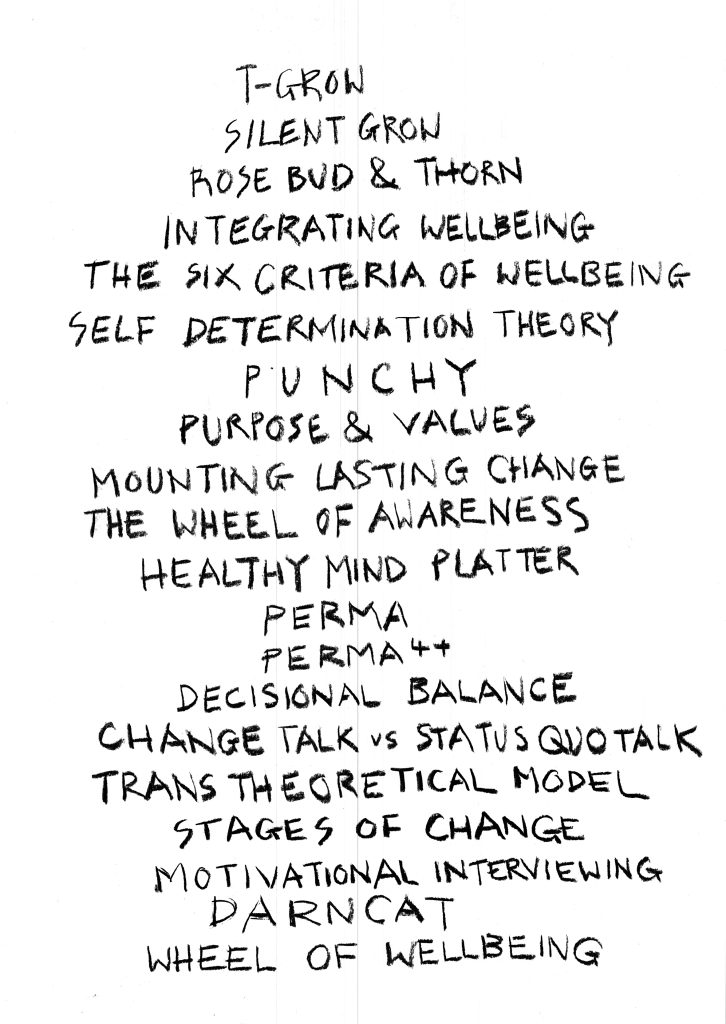
The image shows a hand written list of Wellbeing Coaching models and tools written in capital letters in black charcoal on a white background. The list from top to bottom reads: 
T-GROW 
Silent GROW 
Rose, Bud & Thorn 
Integrating Wellbeing
The Six Criteria of Well-Being 
Self-Determination Theory 
PUNCHY 
Purpose & Values 
Mounting Lasting Change 
The Wheel of Awareness 
Healthy Mind Platter
PERMA
PERMA⁴⁺ 
Decisional Balance 
Change Talk vs Status Quo Talk 
Transtheoretical Model 
Stages of Change 
Motivational Interviewing 
D.A.R.N.C.A.T. 
Wheel of Wellbeing

During the residency I am trying to finish an assessment for a wellbeing coaching course. This is a list of wellbeing coaching models and tools. It’s not, nor ever will be, exhaustive…

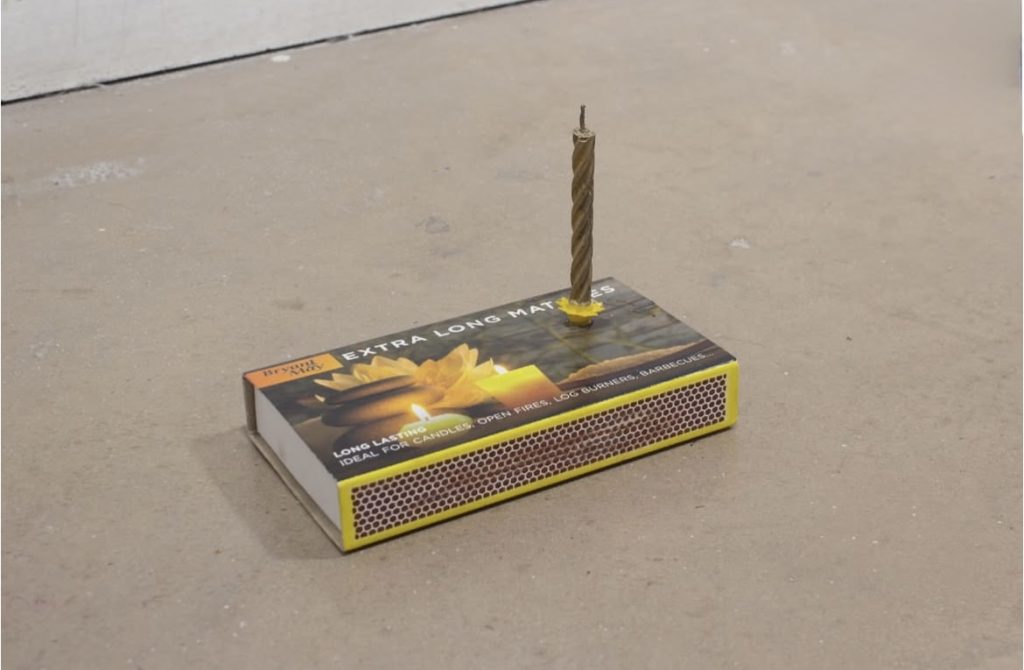
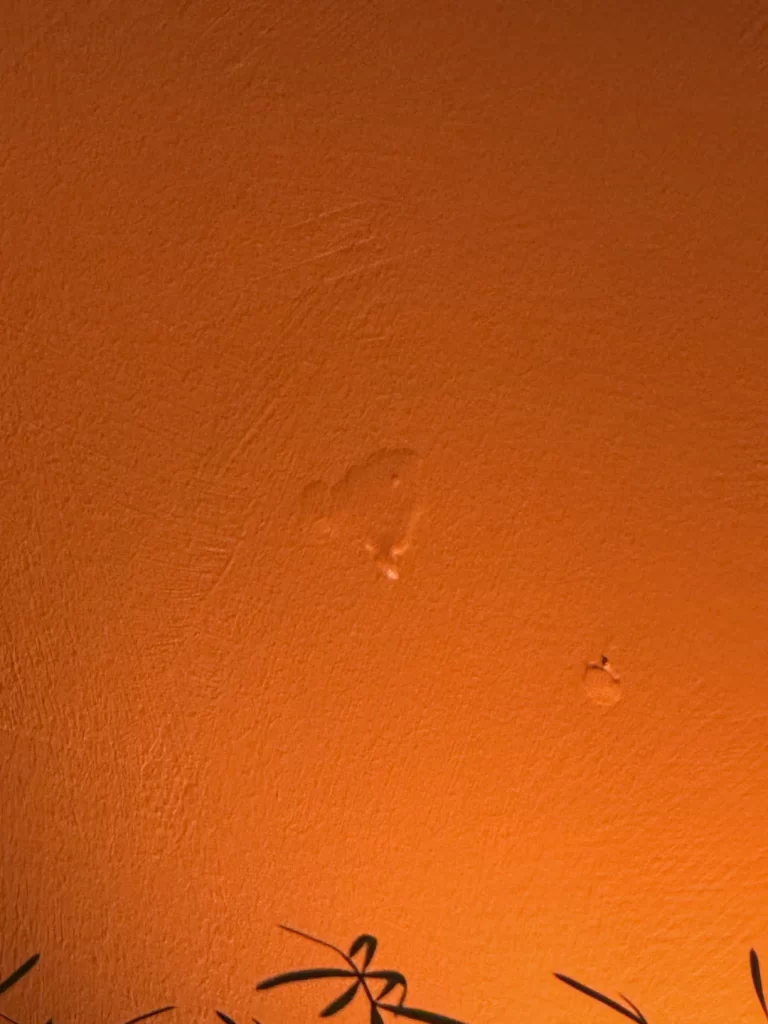
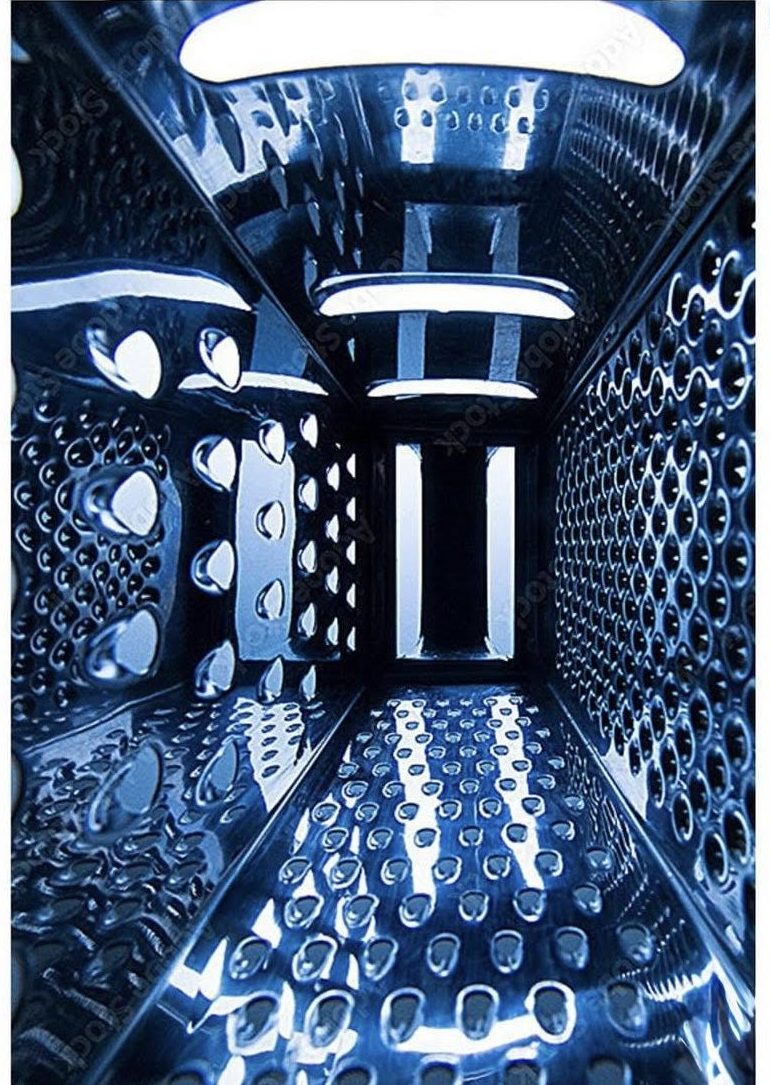
ceiling, moth & cheese

Left: c. mae bloom, Firelights flickering on the ceiling of the world, 2025.

Middle: Foresaken-Werewolf-23, r/mildinginteresting/, Reddit, Peice of plaster on my wall looks like someone painted over a moth or butterfly, 7mo ago

Right: Vince Moriarty, Positive Quotes Diaries, Facebook, Does the inside of a cheese grater qualify as a liminal space? 9 January 2024

Audio recording by Papa Moor

starting point – rejected application snippet

‘Votive offerings and talismans, toys (especially transitional objects), small scars, dents or details: the minute holds power far beyond its size. I’m interested in how small-scale things affects the viewer, inviting a sense of play that involves a familiar projection tied to the uncanny. We shrink to fit into a very real yet psychologically activated world while assuming some authority over it. However, what seems endearing “under the thumb” becomes less so when we realise its scale actually limits its visibility.

Small details or objects, particularly animate ones like insects, can be seriously disconcerting – hence why close-ups are so often used in horror films to build tension or foreshadow what’s to come, hinting that the threat is unlikely to be entirely visible, containable or predictable. This capacity to pass unnoticed or remain hidden can also feel intimate – a small mark on a wall, an object tucked into an inside pocket, strung against a chest, or held in a fist.’

HOW TO START WITHOUT STARTING

I can’t be there for the first residency meeting. I talk to Jamie about how sad I am about this: that I can’t even meet the requirements of the residency from day one. We say of course that is ok, and I think about my studio text which says that I am embracing failure during this residency, but I still find it difficult to reconcile with the normative structures I have internalised.

Section of a flowchart diagram in black hand written and printed text on a white background illustrating a daily routine on a workday in September 2022, focusing on managing pain and work activities throughout the day. Key decision points include pain levels, use of painkillers, exercise, work tasks, meals, and rest. Work tasks are organised in the centre, with labelled boxes and arrows spiralling around with multiple complex choices and actions.

(Un)productive Spatialisations #1 (detail) (2022)

This situation makes me think about my drawing ‘(Un)Productive Spatialisations’ which I made in 2022 to highlight the work to get to make work. I am not in the same place as I was when I made this diagram, which tracks the granular choices a ‘sick’ bodymind makes to get to make work; to be in public, but it resonates with me now in a different way as I work with my sister to care for my mum. All the hidden labour that goes into living is in my mind and how this affects bodyminds in different ways – whether it’s the work of the ‘sick’ body, or the work to make work, or the work to care for someone else’s needs – all of which disproportionately affect those bodyminds whose needs aren’t seamlessly met by the environment around them.

Flowchart diagram in black hand written and printed text on a white background illustrating a daily routine on a workday in September 2022, focusing on managing pain and work activities throughout the day. Key decision points include pain levels, use of painkillers, exercise, work tasks, meals, and rest. Work tasks are organised in the centre, with labelled boxes and arrows spiralling around with multiple complex choices and actions.
(Un)productive Spatialisations #1 (2022)

I am grateful that Jamie says it’s fine that I can’t make it, and I viscerally relearn Alison Kafer’s critical aspect of crip time: that it’s more than fine to meet the day, the residency, the work as you are, rather than bend your body and mind to meet the clock, in fact, it’s fundamental.

I’ve included the audio description of the diagram by Char Heather as this is something I would like to explore more of during the residency. It’s an excerpt from a longer description which was written and recorded by Char for the project Public S/Pacing at Bloc Projects, Sheffield in 2024.

WELCOME TO MY STUDIO

The photograph shows me standing vertically wrapped in a large red blanket. I am facing away from the camera. White typewriter text at the bottom of the blanket reads Chronic. I am standing on a concrete floor in front of a large billboard printed with tropical ferns. Behind the billboard is a large indoor greenhouse with pine trees and wooden architectural structures.
Public S/Pacing (2024) image: Julian Hughes

Hi, I’m Helen Stratford, I’m an artist-architect and academic. I live and work in between the Cambridgeshire Fens and Sheffield.

I have a social practice that embraces performance, art, architecture, speculative diagramming, writing and civic action. Changing life experiences have led me to recalibrate my practice.  Exploring personal worlds of pain, health and limited energy, my current work seeks to re-encounter, subvert, or ‘crip’, public spaces and practices built around expectations of hyper-productivity and optimisation; re-interpreting them with care and humour.

At this moment in creatively and sustainably embedding my lived experience in my work, I believe in centring ‘crip time’ – how disabled, sick, and Mad bodyminds navigate time/space – as a critical tool for innovative forms of art.

During the residency I am planning to work between drawing and performance-based actions to develop an interactive space that invites audiences to examine the tensions and ecologies between work, wellness and (radical) rest. I am excited to use this time to connect with my peers in exploring how places of friction, failure, unknowing and ridicularity might critique the normative and extractive presumptions that structure daily life, and support modes of self-care and mutual aid. The residency is a direct development of an Arts Council England DYCP grant (2025/26) exploring ‘Ecologies of Crip Time.’

Please take some time to look around my studio, at the work and thoughts. Feel free to ask questions and get in touch through the comments! 

With care

Helen

Welcome to my studio

Hi, I’m Mariette Moor, welcome to my digital studio.

My physical studio is currently my bed, a markedly horizontal departure from my previous setup which operated from a strictly upright position: working with all kinds of sculptural materials, disappearing into intensive drawing stints, and collaborating with some wonderful people. 

I’m now experimenting with how to make work while stuck inside with a chronic illness that has, over the last two years, shrunk my world to a very small square footage. My practice has continued to develop, but only in my head, which turns out to be a very interesting, if pretty repetitive, place.

During this residency, I’ll be trying to collaborate with my current circumstances, which are eerily connected to my previous research into horror, intimacy, and scale. My relationship with these subjects has shifted since living in a chronically ill body, within a house shaped by intertwined care roles and health conditions.

Thanks for taking a look. Feel free to get in touch.

Warm wishes,

Mm x

Introducing Vital Capacities 2026 artists

Resident artists, August 2026 clockwise from top left: Sophie Hoyle, Mariette Moor and Helen Stratford

For the 12th Vital Capacities residency, we partner with Film London Artists’ Moving Image Network and Wysing Arts Centre to work with UK-based artists. From 1 August, artists Sophie HoyleMariette Moor and Helen Stratford will join Vital Capacities to undertake research and develop new work. Over the month-long online residency, the artists will explore new ideas, connect across disciplines and geographies, and experiment within their digital studio spaces.

The artists for August 2026’s residency are:

Sophie Hoyle is an artist and writer who relates personal experiences of being queer, non-binary, disabled and part of the SWANA (South-West Asian and North African) diaspora to wider forms of structural violence. From lived experience of psychiatric conditions and trauma (or PTSD), they began to explore the politics of healthcare inequalities and collective and intergenerational trauma. 

cannibal licks tricks stuffed sticky body undone untouched mutate to escape by the skin of our teeth

Mariette Moor‘s interdisciplinary practice holds drawing, clay and writing at its core, operating as modes of storytelling that tease at the uncanny peripheries of horror and their relationship to boundaries, absence, and control. I imagine ‘world fracturing’ as a methodology to mix the mundane, fantastical and paranoid into psychological scenes, questioning the nature of reality and sanity. Tenderness and violence coexist in speculative bodies and spaces which confront the complexities of intimacy.

Helen Stratford’s practice spans architecture, fine art, writing and research. Through performative workshops, site-specific interventions, video, speculative writing, and discursive platforms, they propose ways of challenging spatial prejudices produced at the intersections of social, cultural, economic and political relations. Her work has been exhibited at V&A, Oslo Architecture Triennale, Yorkshire Sculpture Park, Bloc Projects, Kettle’s Yard and Wysing Arts Centre. Led by her lived experience of chronic pain and personal health histories, she is currently researching crip time (en)counters with public space, ecology, architecture, and productivity. Helen is also Senior Lecturer at Sheffield Hallam University.

An online exhibition showcasing work developed during the residency will be presented on vitalcapacities.com, launching on 24 September 2026.

Residency launches on 1 August – find out what the artists are up to by following their progress at: vitalcapacities.com and on Instagram: @vitalcapacities

Vital Capacities is an accessible, purpose-built digital residency space, that supports artists’ practice while engaging audiences with their work.

Vital Capacities has been created by videoclub in consultation with artists, digital inclusion specialist Sarah Pickthall and website designer Oli Pyle.

Vital Capacities 2026 residency is supported by Arts Council England.

Artful Image Processing and Algorithmic Drawing

Having set up the object detection pipeline, I proceeded to the image processing stage, where the raw visual data and the model’s outputs are transformed into a more artistic representation. My process involved several key steps. First, I applied edge detection algorithms to the video frames. This technique identifies points in a digital image where the brightness changes sharply, effectively outlining the shapes and contours of objects in the scene. Next, I inverted the black and white colour, creating a stark, high-contrast visual style. Finally, I took the bounding boxes generated by the YOLO detection model and redrew them onto this processed image. This layering of machine perception over a stylised version of reality creates a compelling visual dialogue between the actual scene and the AI’s interpretation of it.

Processing Perceptions with YOLO and the COCO Dataset

With the video pipeline established, I turned my attention to processing the visual data using a combination of powerful tools. The core of this stage is the YOLO (You Only Look Once) object detection model. YOLO is a state-of-the-art, real-time object detection system that identifies and classifies objects in a single pass of an image, making it incredibly fast and efficient. For this project, I am intentionally using the model with the pre-trained COCO (Common Objects in Context) dataset. The COCO dataset is a large-scale collection of images depicting common objects in everyday scenes and is a standard benchmark for training and evaluating computer vision models.

My goal is not to achieve flawless object recognition but rather to play with the inherent “mistakes” and misinterpretations the machine makes. The default COCO dataset is perfectly suited for this, as its generalised training can lead to incorrect predictions when applied to novel or ambiguous scenes. To manipulate the image data, which is essentially a collection of pixels, I am using NumPy (Numerical Python). NumPy is a fundamental library for scientific computing in Python that allows for efficient manipulation of large, multi-dimensional arrays and matrices—the very structure that represents digital images.

What is Object Detection?

Object detection is a field of computer vision and image processing concerned with identifying and locating instances of objects within images and videos. Unlike simple image classification, which assigns a single label to an entire image, object detection models draw bounding boxes around each detected object and assign a class label to it, providing more detailed information about the scene.

What are NumPy and the COCO Dataset?

  • NumPy: A Python library that provides support for large, multi-dimensional arrays and matrices, along with a collection of mathematical functions to operate on these arrays. In image processing, an image is treated as a 3D array (height, width, colour channels), making NumPy an indispensable tool for any pixel-level manipulation.
  • COCO Dataset: Standing for “Common Objects in Context,” this is a massive dataset designed for object detection, segmentation, and captioning tasks. It contains hundreds of thousands of images with millions of labelled object instances across 80 “thing” categories and 91 “stuff” categories, providing a rich foundation for training computer vision models.

Objects Detectable by the COCO Dataset:

The COCO dataset can identify 80 common object categories, including:

  • People: person
  • Vehicles: bicycle, car, motorcycle, airplane, bus, train, truck, boat
  • Outdoor: traffic light, fire hydrant, stop sign, parking meter, bench
  • Animals: bird, cat, dog, horse, sheep, cow, elephant, bear, zebra, giraffe
  • Accessories: backpack, umbrella, handbag, tie, suitcase
  • Sports: frisbee, skis, snowboard, sports ball, kite, baseball bat, baseball glove, skateboard, surfboard, tennis racket
  • Kitchen: bottle, wine glass, cup, fork, knife, spoon, bowl
  • Food: banana, apple, sandwich, orange, broccoli, carrot, hot dog, pizza, donut, cake
  • Furniture: chair, couch, potted plant, bed, dining table, toilet
  • Electronics: tv, laptop, mouse, remote, keyboard, cell phone
  • Appliances: microwave, oven, toaster, sink, refrigerator
  • Indoor: book, clock, vase, scissors, teddy bear, hair drier, toothbrush

Weaving a World Model with Reinforcement Learning Concepts

With a large dataset of generated policies, the next step is to import them back into the primary software application that displays the 360-degree video. This integration allows the dynamically generated rules to influence the visual output or behaviour of the system in real-time. My use of the term “policy” is a deliberate nod to its origins in the field of Reinforcement Learning (RL), a concept dating back to the 1990s. In RL, a policy is the strategy an agent employs to make decisions and take actions in its environment. It is the core component that dictates the agent’s behaviour as it learns through trial and error to maximise cumulative reward. By generating policies based on visual input, my system is, in a sense, creating its own world model—a simplified, learned representation of its environment and the relationships within it. This process echoes the fundamental principles of how an AI agent learns to react to and make sense of the real world, a topic I have delved into in more detail in some of my earlier writings.

Generating AI Policies from Object Proximity

In a more experimental turn, I developed a separate piece of software to explore the concept of emergent behaviour based on the object detection output. This program uses a Large Language Model (LLM) to generate “policies” when objects from the COCO dataset are detected in close proximity on the screen. The system calculates the normalised distance between the bounding boxes of detected objects. This distance value is then fed to the LLM, which has been prompted to generate a policy or rule based on the perceived danger or interaction potential of the objects being close together. For instance, if a “person” and a “car” are detected very close to each other, the LLM might generate a high-alert policy, whereas a “cup” and a “dining table” would result in a benign, functional policy. This creates a dynamic system where the AI is not just identifying objects, but also creating a narrative or a set of rules about their relationships in the environment.

Setting the software with 360-Degree Vision

The initial phase of this project involved tackling the technical groundwork required to process 360-degree video. I began by using OpenCV, a powerful open-source computer vision library, to stitch together the two separate video feeds from my 360-degree camera. OpenCV is an essential tool for real-time image and video processing, providing the necessary functions to merge the hemispheric views into a single, equirectangular frame. After successfully connecting the camera to my computer, I set up a basic Python workspace within my integrated development environment (IDE). The next step was to write a script that could access the camera’s video stream and display it in a new window, confirming that the foundational hardware and software were communicating correctly. This setup provides the visual canvas upon which the subsequent layers of AI-driven interpretation will be built.

Embracing the Algorithmic Uncanny

I am revisiting a creative process that has captivated my interest for some time: enabling an agent to perceive and learn about its environment through the lens of a computer vision model. In a previous exploration, I experimented with CLIP (Contrastive Language-Image Pre-Training), which led to the whimsical creation of a sphere composed of text, a visual representation of the model’s understanding. This time, however, my focus shifts to the YOLO (You Only Look Once) model. My prior experiences with YOLO, using the default COCO dataset, often yielded amusingly incorrect object detections—a lamp mistaken for a toilet, or a cup identified as a person’s head. Instead of striving for perfect accuracy, I intend to embrace these algorithmic errors. This project will be a playful exploration of the incorrectness and the fascinating illusions generated by an AI model, turning its faults into a source of creative inspiration.

* visualization using CLIP and Blender for artwork “Golem Wander in Crossroads”

Ultralytics YOLO

https://docs.ultralytics.com

Ultralytics YOLO is a family of real-time object detection models renowned for their speed and efficiency. Unlike traditional models that require multiple passes over an image, YOLO processes the entire image in a single pass to identify and locate objects, making it ideal for applications like autonomous driving and video surveillance. The architecture divides an image into a grid, and each grid cell is responsible for predicting bounding boxes and class probabilities for objects centered within it. Over the years, YOLO has evolved through numerous versions, each improving on the speed and accuracy of its predecessors.
(Text from Gemini-2.5-Pro and edited by artist)

CLIP

https://github.com/openai/CLIP

CLIP (Contrastive Language-Image Pre-Training), developed by OpenAI, is a neural network that learns visual concepts from natural language descriptions. It consists of two main components: an image encoder and a text encoder, which are trained jointly on a massive dataset of 400 million image-text pairs from the internet. This allows CLIP to create a shared embedding space where similar images and text descriptions are located close to one another. A key capability of CLIP is “zero-shot” classification, meaning it can classify images into categories it wasn’t explicitly trained on, simply by providing text descriptions of those categories.

(Text from Gemini-2.5-Pro and edited by artist)

COCO

https://cocodataset.org/#home

https://docs.ultralytics.com/datasets/detect/coco

COCO (Common Objects in Context), is a large-scale object detection, segmentation, and captioning dataset. It is designed to encourage research on a wide variety of object categories and is commonly used for benchmarking computer vision models. It is an essential dataset for researchers and developers working on object detection, segmentation, and pose estimation tasks.

(Text from Ultralytics YOLO Docs)

Return to Earth: Buzz Aldrin’s Autobiography

A book standing spine-up on a dark cherry wood surface. It is old and beaten up, worn-out blue, with faded gold lettering that just about reads: RETURN TO EARTH. More text underneath and to the side are illegible. It casts a monolithic shadow in front of itself.

I read Buzz Aldrin’s autobiography ‘Return to Earth’ in 2020/1 as part of my research for The Siren of the Deep – a solo show I did at Eastside Projects in Birmingham. The arc of it has stayed with me ever since, and is a part of this work too, so I’ve come back to it now. He describes his whole life leading up to the moon landing – achieving excellence in every stage of the specific path he’d cut out for himself (or sometimes by others), until this extreme pinnacle of achievement – something no-one else had ever done before himself and Niel Armstrong – a transcendence so astounding it had previously barely been imaginable. But then what? This is the bit I’m interested in. He ended up in a psychiatric hospital, because the depression that followed was too much to cope with. Because, what do you do after you’ve landed on the moon? 

I think this is the hole that apophany fills: the absence of epiphany.

An open book. On the left page is a black and white photo of an astronaut in their suit. In the reflection of their helmet is the sketchy figure of someone else, or perhaps just some equipment. The horizon in the reflection and behind the astronaut is black, meeting the edge of the moon they’re standing on. On the right page is text in a dated font which reads ‘RETURN TO EARTH, Colonel Edwin E. “Buzz” Aldrin, Jr., with Wayne Warga, Random House, New York.’ A white hand holds the book open, a milky painted thumbnail pins down the left page at the bottom. The book is resting on a white surface.

The Dream Pool Backrooms

A computer generated image of a room covered in white tiles, from ceiling to walls to floor. In its centre is a circular hole in the ceiling through which a pillar extends, and a staircase spirals around. The room is half full of turquoise water. In the background, a tunnel leads elsewhere.

Since I went to Bath, I’ve been dreaming about its backrooms. Divots in sandy stone filled with green water that I can slide my arm into, an exact fit. Semi-organic cave networks getting darker and deeper, pools of water deep and shallow suspended and plunging at different levels.

Do you know about The Backrooms? They’re this concept of liminal spaces, usually devoid of living beings, that you can enter by leaving reality. There’s a Dream Pool genre of Backrooms that I’ve been following for a while, and earlier this year a game: Dreamcore, came out which holds a lot of these to explore. There’s something cyclical about recognising these as a pocket of your subconscious mind, then taking the images back into your sleep…

Another entirely tiled room. These tiles are pastel pink, and in the centre of the room is a hexagon shaped pool full of water. The room follows its shape and two doorways are opposite us, on two of the sides of the shape. One leads to darkness, it looks like a stairway downstairs. The other has a staircase upstairs, and an orange rectangular light from an unknown source illuminates it.
Another tiled space, this one dark and gloomy. It's the corner of a swimming pool from above, where the metal ladder leads into the water. It plunges down into an unrealistic depth, mysterious and dark.
A room in a 1960s minimalist style. An expanse of plain floor and ceiling space, marked only by the reflections of ripples of an oblong pool on the left. These reflections also pick out a large sphere at the back of the room, a plain sofa on the right, and some more ornamental sphere shapes, much smaller. Above the pool is a black expanse, perhaps a night sky, perhaps a blank ceiling.
A sunlit white tiled interior. The walls curve in a wavy line, a long thin pool following them, and a pillar that seems architecturally functionally useless. At least, according to waking logic.
A dark underground space, all tiled. It looks like a subway or somewhere corporate and abandoned - but only recently - a still living plant in a plant box at the right. The kind you find outside an office block. A stairway upwards leads to darkness, and an ankle-deep measure of water pervades throughout, strangely purple, showing ripples of movement from nothing we can see capable of motion. It seems lit by a torch, whilst the edges recede into blackness.
A dark white tiled space with a winding thin pool lit by spotlights from above. A rubber ring floats on its surface next to a metal ladder leading into it.
A very creepy pool interior. An abandoned public swimming pool - a colourful spiral flume at the left, and a converted industrial looking ceiling with institutional lighting. But they don't fully light the space, it's a bit too dark to be comfortable, and unnervingly misty.
A sunlit white tiled interior, half full of turquoise water. Two doorways on different wall in front of us fall back into a never-ending series of doorways behind them.

More moments

A hand hangs out of the car window and is reflected in the wing mirror. The road behind doesn't look too busy.
A hand hangs out of the car window and is reflected in the wing mirror. The fingers are stretched out as if trying to reach or perhaps gently asking for attention. The road behind gets busier. There is a double decker bus and lorry approaching.
A hand hangs out of the car window and is reflected in the wing mirror. The fingers are straight but relaxed as if trying to gently asking for attention or maybe feeling a breeze. The road behind gets busier. There is a double decker bus and the lorry passes by.

Sometimes accidents can be so difficult to recreate. Sometimes in trying to recreate them, they can lead to new things. I loved the gentleness of the hand compared to all the noise and traffic in the background. Not sure if the gesture is quite what I’d like it to be yet.