
 Accessing this site
 Display settings
 Artist login

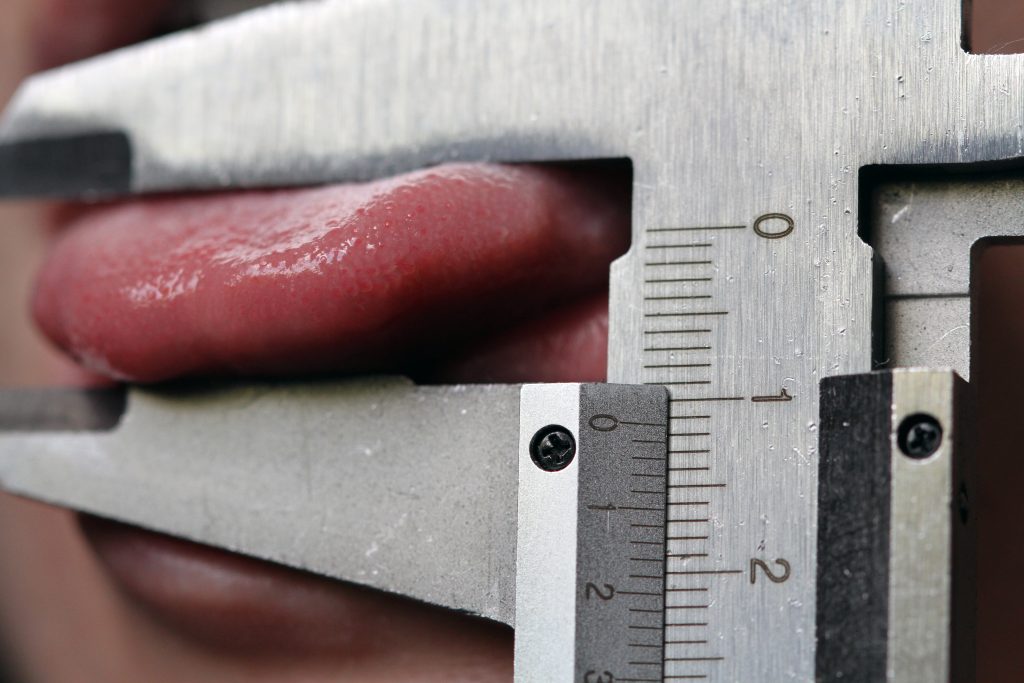
Image Description: A close-up colour photograph of a pale person’s face with a silver metal measuring instrument (sliding calipers) around their tongue. To the centre-left of the photo the person’s pink-red tongue is sticking out of their mouth, and held in the grip of the metal calipers, which has two straight metal edges that taper to the left, just above and just below the tongue; they almost look like blades of scissors. There is a blurred outline of their lips behind the calipers. To the centre-right of the photo, the calipers are measurements in black numbers (showing centimetres and millimetres), punctuated by straight black horizontal lines. On the calipers there are different metal parts of different thickness showing that it has adjustable moving parts, and small black screws holding some of these different parts in place. The cold grey-silver colours of the metal contrast with the warm pink-red colours of the tongue and skin.
‘Measured Speech’ is a phrase used to describe someone who is talking in a slow, considered and regulated way. I’m interested in how we learn speech for communication, self-presentation and social acceptance. Speech, accent and pronunciation can be formed by experiences of race, gender, class, disability, nationality, and can enable access or be part of barriers to certain spaces, based on social assumptions and prejudices.
Speaking in a ‘measured’ way can make you appear more ‘reasonable’, ‘professional’ (in some contexts), more ‘amenable or ‘emotionally regulated’; in a medical context as a patient it can make what you say seem more ‘believable’, that you have a ‘rational’ assessment of your symptoms and experiences. In terms of psychiatric diagnoses, one of the criteria of mental health conditions or ‘pathologies’ is ‘dysregulated speech’; it’s contradictory that in order to communicate that you’re in acute mental distress, you have to do so in a way were you are self-composed enough to articulate this through speech. Many people with psychiatric conditions including Post-Traumatic Stress Disorder describe how impossible it is to articulate their experiences and symptoms through language, like you’re being asked to express the inexpressible.
In being a pale person of mixed heritage, I’m also interested in how people construct race through external physical markers e.g. skin colour, hair colour, eye colour. The history of genetics and categorisations of external physical characteristics (phenotypes) strongly ties in with histories of racism, white supremacy and eugenics. Some of the methods of analysing difference include Anthropometry, or measuring parts of the body, which was used in scientific racism to categorise and hierarchise groups of people and make assumptions about their ‘intelligence’ and by extension their whole societies as ‘civilised’ or not. Different kinds of calipers are some of the tools used to measure body parts in Anthropometry.


