
 Accessing this site
 Display settings
 Artist login

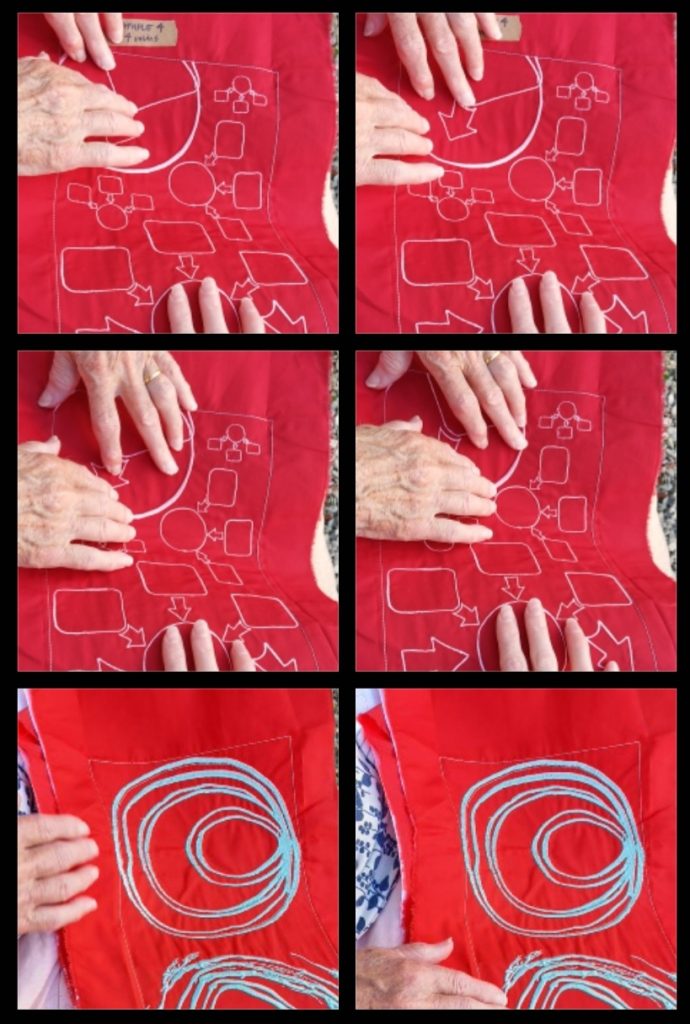
I show my mum my current work-in-progress. She is partially sighted, so the showing becomes a feeling. Tracing the lines of embroidery with our fingers, we talk and laugh about wellness models, illness and autonomy through a tactile and sensory conversation.
In the 1950s my mum worked on garments for Queen Elizabeth II as a dressmaker for a London Fashion house. One of the dresses she worked on is currently on display at the King’s Gallery. This is exactly the sort of exhibition I try to avoid. The exhibition centres garments produced for royal ceremonies and state occasions, histories inseparable from empire and colonisation. Yet, I became emotional when my sister, niece and I recently took my mum to see the dress we’d heard about (repeatedly) all our lives.
The feeling is difficult to untangle. Partly it was seeing my mum encounter a piece of her own history. Partly it was the accumulation of years of stories suddenly materialising in front of us. Partly it was an awareness of all the other hands that remain absent from the story. I found myself wanting to find all the hands that worked on these exquisite outfits: the hundreds of unnamed workers whose labour supported state weddings, coronations and diplomatic visits; work entangled with wealth drawn from extracted lands and colonial systems. Their contributions remain largely invisible while the finished garments become objects of national celebration. At the same time, I was frustrated by the lack of access design. The hand-drawn sketches that accompanied the garments were displayed too high for my mum to see from her wheelchair.
There is no touching in the exhibition, only admiration.


