WELCOME TO MY STUDIO

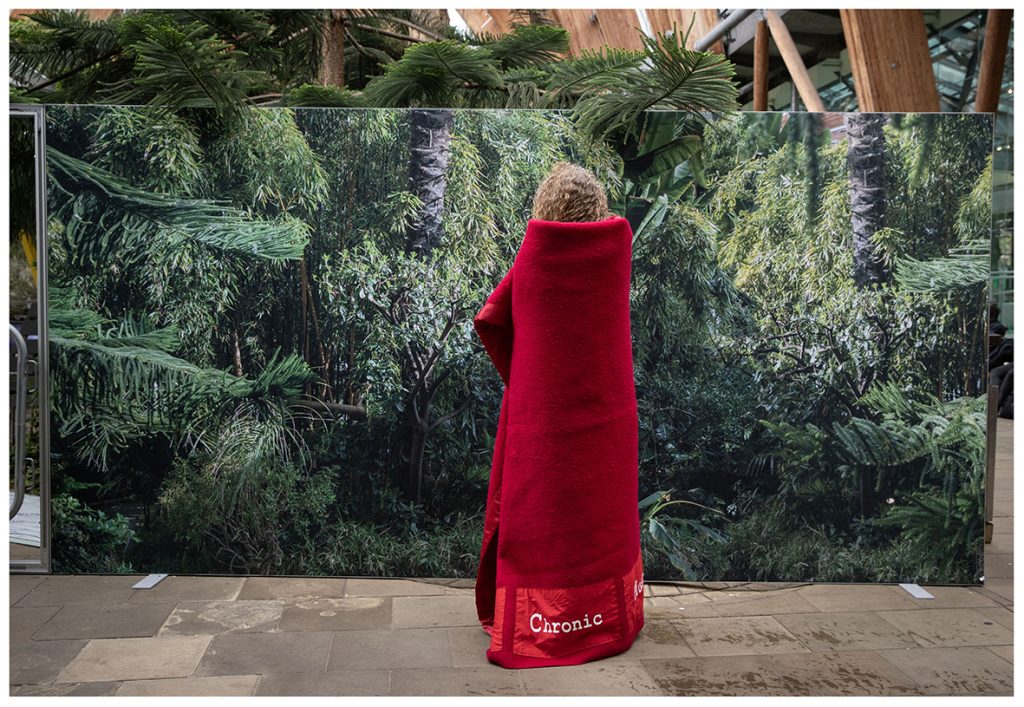
The photograph shows me standing vertically wrapped in a large red blanket. I am facing away from the camera. White typewriter text at the bottom of the blanket reads Chronic. I am standing on a concrete floor in front of a large billboard printed with tropical ferns. Behind the billboard is a large indoor greenhouse with pine trees and wooden architectural structures.
Public S/Pacing (2024) image: Julian Hughes

Hi, I’m Helen Stratford, I’m an artist-architect and academic. I live and work in between the Cambridgeshire Fens and Sheffield.

I have a social practice that embraces performance, art, architecture, speculative diagramming, writing and civic action. Changing life experiences have led me to recalibrate my practice.  Exploring personal worlds of pain, health and limited energy, my current work seeks to re-encounter, subvert, or ‘crip’, public spaces and practices built around expectations of hyper-productivity and optimisation; re-interpreting them with care and humour.

At this moment in creatively and sustainably embedding my lived experience in my work, I believe in centring ‘crip time’ – how disabled, sick, and Mad bodyminds navigate time/space – as a critical tool for innovative forms of art.

During the residency I am planning to work between drawing and performance-based actions to develop an interactive space that invites audiences to examine the tensions and ecologies between work, wellness and (radical) rest. I am excited to use this time to connect with my peers in exploring how places of friction, failure, unknowing and ridicularity might critique the normative and extractive presumptions that structure daily life, and support modes of self-care and mutual aid. The residency is a direct development of an Arts Council England DYCP grant (2025/26) exploring ‘Ecologies of Crip Time.’

Please take some time to look around my studio, at the work and thoughts. Feel free to ask questions and get in touch through the comments! 

With care

Helen
STRANGE-ING TIME

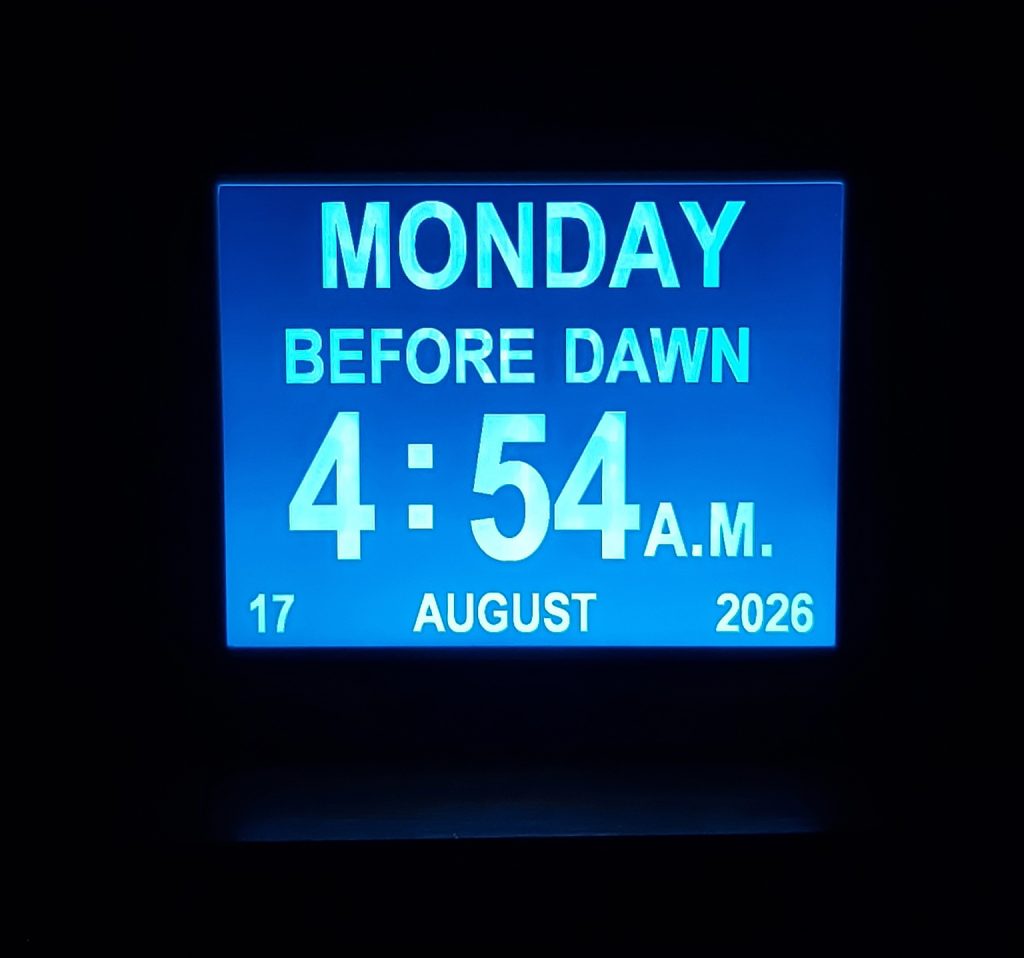
A bright blue digital display set against a black background reads ‘Monday Before Dawn’ in capital letters above the time 4:54 a.m. in larger numbers in the centre of the screen. Running along the bottom of the screen the date reads: 17 August 2026. There is a reflected light from a mantlepiece and the illuminated screen emphasizes the stillness and darkness of the pre-dawn hour.

I am back at my mum’s. At first, I think I can’t continue with the residency process in this space: practices of art and care feel in direct tension. But then I start thinking about how conventional Western ideas of neoliberal productive time hold very little meaning here. I think about anti-disciplinary scholar Lisa Bradley’s article ‘Life without Clocks’ in which she tries and fails to ‘strange’ time by living without clocks for 12 days. For Lisa, the failure is not in removing the presence of clocks, rather it is in how the rhythm of time has ‘woven its threads through the fibers of my body long ago.’

Here, caring for my mum, time has not disappeared. It registers in the fading daylight, in ‘morning’ and ‘night’ pills, mealtimes, bin collections and the presence or absence of people passing. But ‘Monday morning’ and the productive week become absurd concepts. I have a vague memory of Friday night, but I’m no longer entirely convinced it exists. Instead, time gathers, circles, drags and folds into repetition, reassurance, waiting and attention. Rather than treating this as an interruption, I lean in.

ON FAILURE

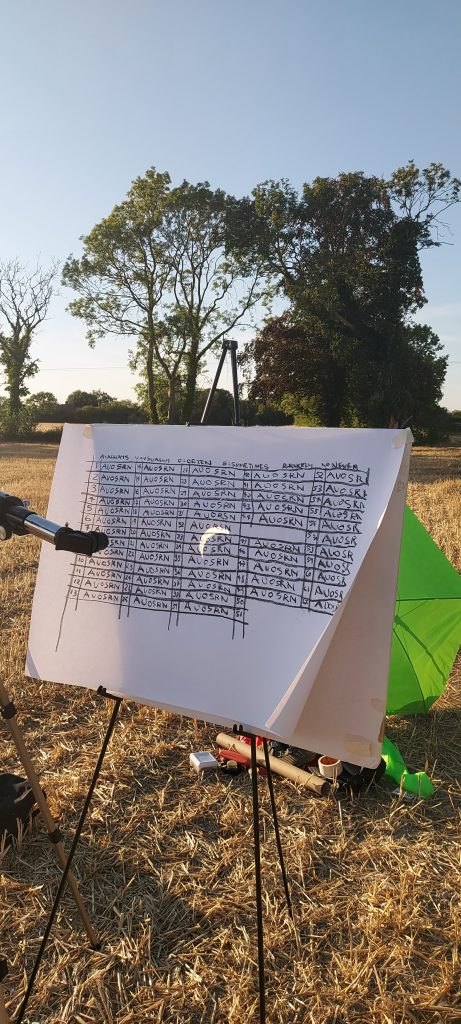
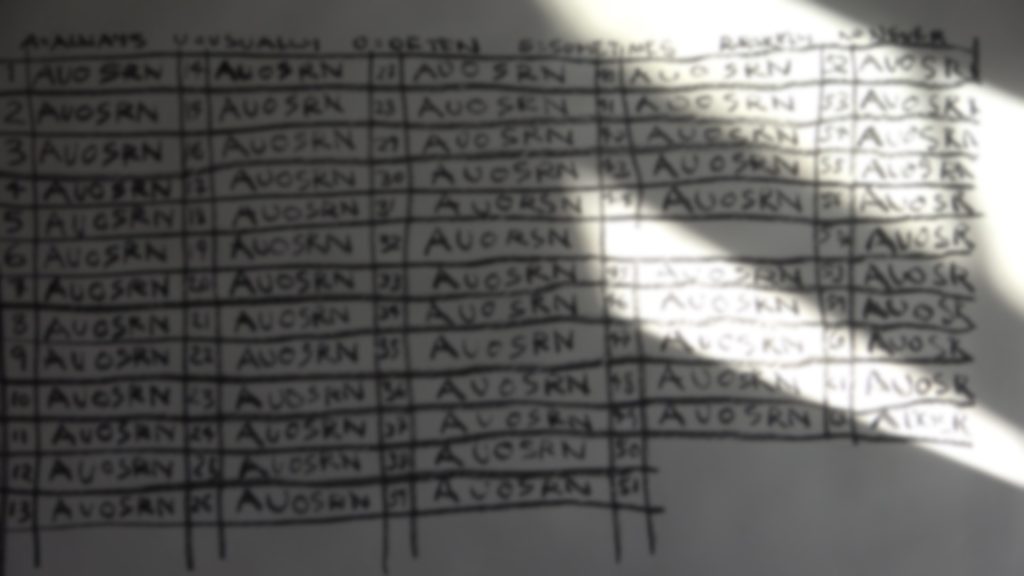
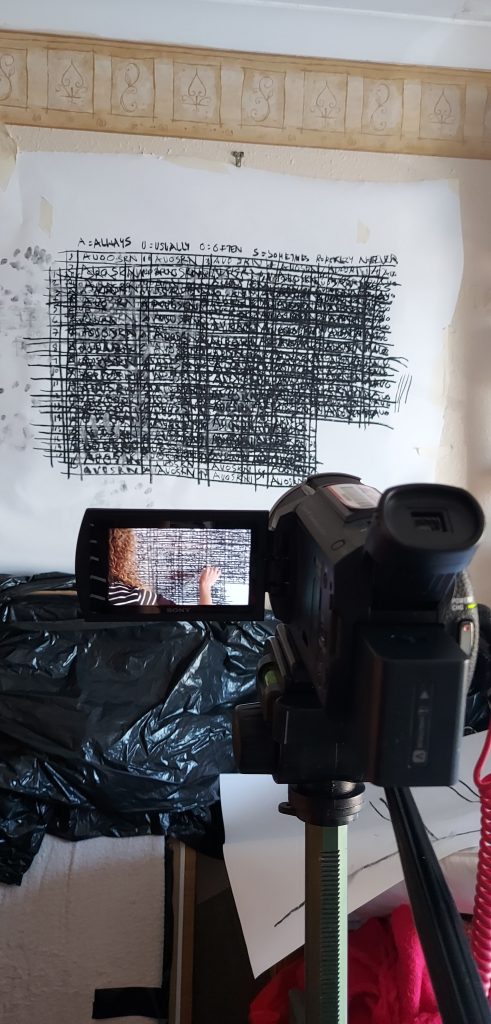
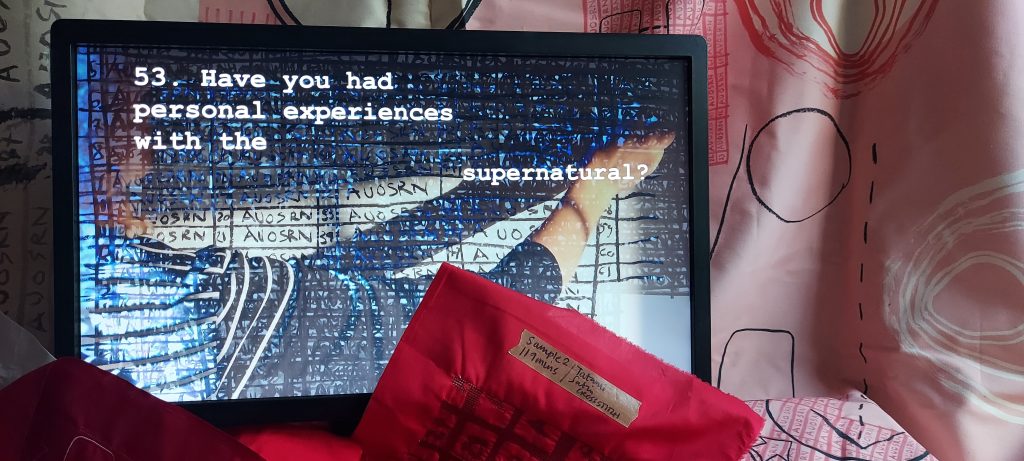
Last week I experimented with filming myself drawing and redrawing the assessment chart. I tried to film in morning light as a way of bringing together two types of time and a link to ecologies (with a nod to Carolyn Lazard and Jade Montserrat). BUT I keep failing, I am not a film maker and the filming is out of focus, is too dark, doesn’t fit in the frame, stops before the end, also, because I am tired, I get up too late for the sun, my body aches from drawing this way and I have to stop repeatedly. It is incredibly frustrating but then I realise this is the process. This is the ridicularity and failure I am trying to embrace. And the rub against normative aesthetic, even architectural, desires to make it neat and tidy is palpable.

A blurry image of a chart of lines, numbers and letters drawn in black on a white background. Most of the image is in shadow with some patches of sunlight on the right which are white and tinged with yellow. The chart is composed of numbers that run from 1 to 62 and repeated letters AUOSRN. At the top there is some indistinguishable writing that appears to be a legend for the chart.
The image shows a video camera on a tripod pointing at a wall. Taped to the wall with masking tape is a large piece of paper. It has ripped edges and looks as if it was cut in a hurry. The wall behind is papered in woodchip wallpaper and painted with magnolia paint, the kind you find in a domestic bedroom, and the top of the wall has a faded decorative wallpaper border with repeating motifs. The paper contains a hand-drawn chart or grid filled with handwritten text and heavy black lines written in deep black charcoal, making much of the content obscured. Across the top are handwritten notes defining letters, including 'A = always, U = usually,' 'O = often,' 'S = sometimes,' and 'R = rarely.' The camera’s fold-out screen displays a close-up view of a hand drawing on the grid. Black plastic sheets cover furniture or stored items beneath the wall.
The image shows a video camera on a tripod pointing at a wall. Taped to the wall with masking tape is a large piece of paper. It has ripped edges and looks as if it was cut in a hurry. The wall behind is papered in woodchip wallpaper and painted with magnolia paint, the kind you find in a domestic bedroom, and the top of the wall has a faded decorative wallpaper border with repeating motifs. The paper contains a hand-drawn chart or grid filled with handwritten text and heavy black lines written in deep black charcoal, making much of the content obscured. Across the top are handwritten notes defining letters, including ‘A = always, U = usually,’ ‘O = often,’ ‘S = sometimes,’ and ‘R = rarely.’ The camera’s fold-out screen displays a close-up view of a hand drawing on the grid. Black plastic sheets cover furniture or stored items beneath the wall.

ALWAYS USUALLY OFTEN SOMETIMES RARELY NEVER

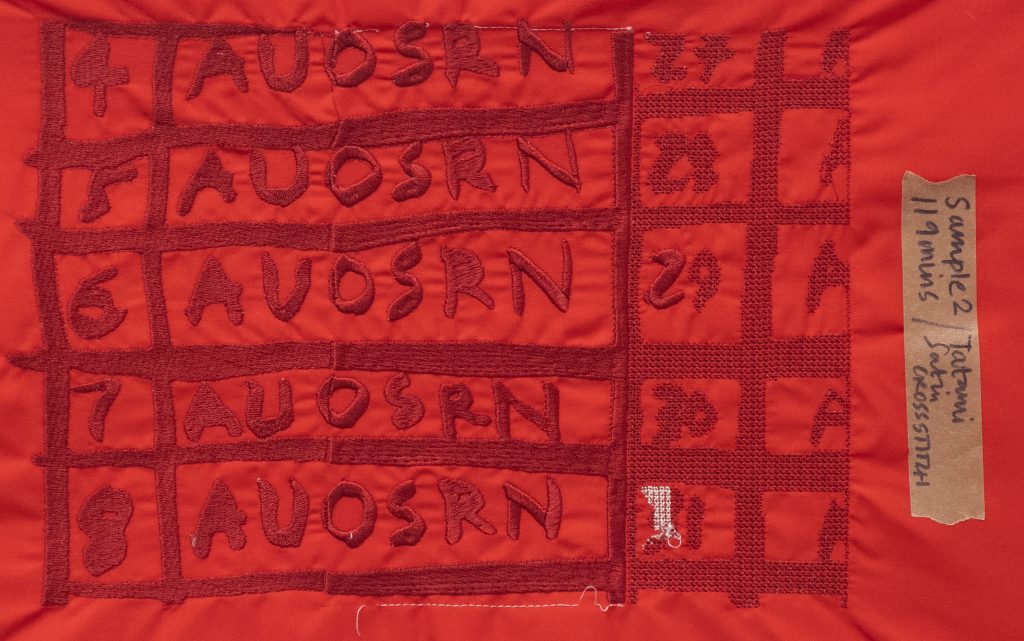
A photograph of deep dark red digital embroidery stitched onto a paler blood red fabric. The embroidery is in the form of a grid with numbers that run from top to bottom 4-8 and 27-31 consequentially and letters that read AUOSRN. The chart is cut off and in places the letters A are cut in half and in others red stitching is over sewn in white. On the right hand side a piece of brown tape with ripped edges has been stuck on the fabric. on the tape hand written text in black felt tip pen reads: Sample 2 119 mins / Tatami Satin CROSSSTITCH.
A photograph of deep dark red digital embroidery stitched onto a paler blood red fabric. Numbers run from top to bottom 4-8 and 27-31 and letters read AUOSRN. On the right hand side is a piece of brown tape with ripped edges stuck to the fabric. On the tape hand written text in black felt tip pen reads: Sample 2 119 mins / Tatami Satin CROSSSTITCH. Image: Josie Turnbull

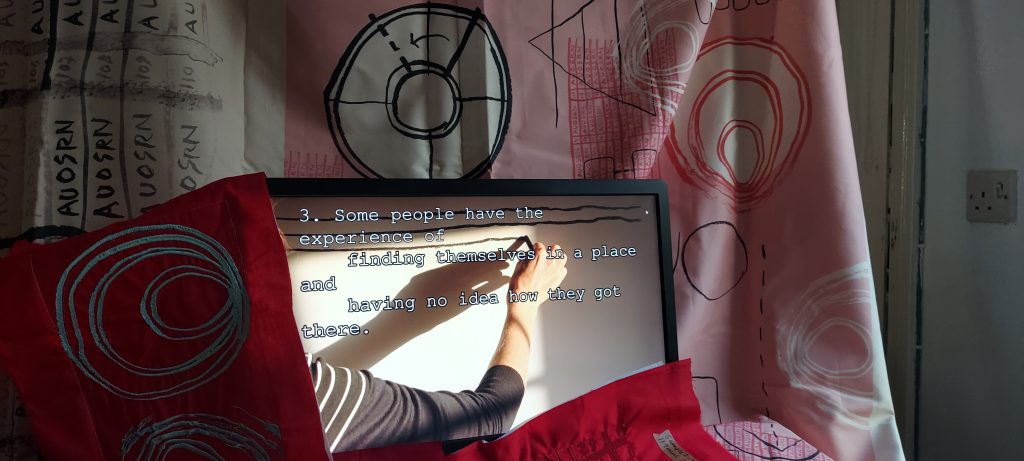
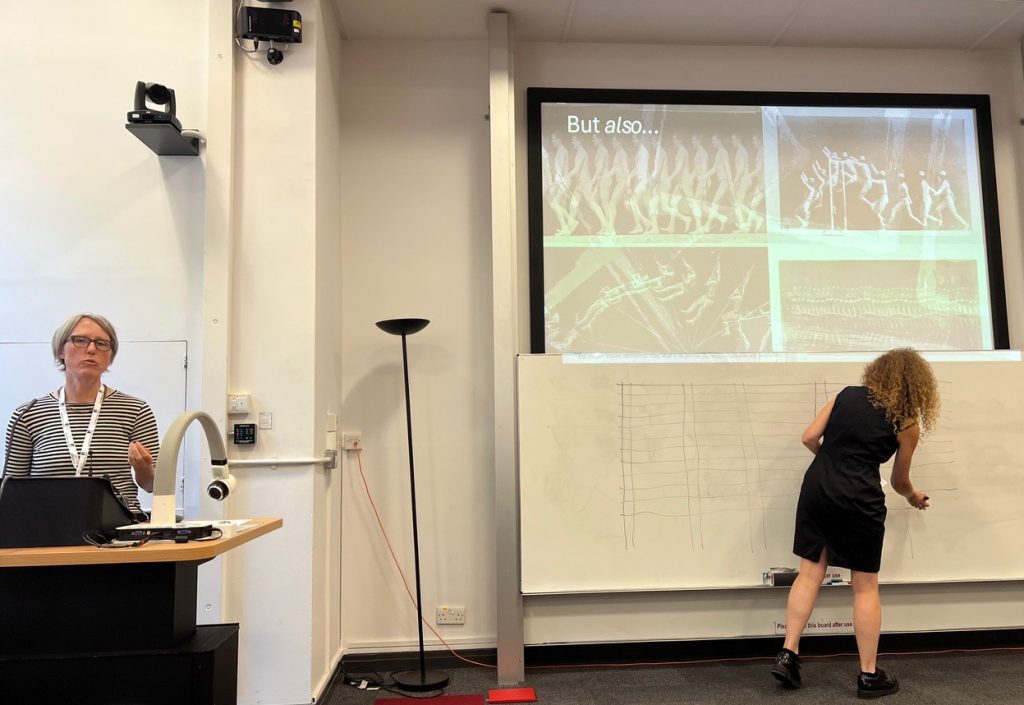
I’ve been redrawing this mental health assessment chart for a while now. I have drawn it in charcoal, in watercolour, in ink, on fabric and translated it into digital embroidery. I am excited to explore where the material of the chart breaks down and fails, but also the performance-based repetitive action of filling in nonsensical questionnaires as an embodiment of crip time. I drew it recently on a whiteboard as part of a performative lecture at a the Society of Social History of Medicine conference at Leeds University with my co-conspirator 20th century healthcare historian Dr Caitjan Gainty. As I drew Caitjan talked about the histories of efficiency and productivity in spaces of work, medicine and healthcare…

The photograph shows a view of the front of a typical lecture theatre or classroom. On the right a projection screen displays 19th-century motion-study photography and chronophotography illustrating human locomotion phases of upright male figures, notably featuring works by Eadweard Muybridge and Étienne-Jules Marey. These were the foundation of 'time and motion' studies by which awkward or redundant movements could be eliminated, tool layouts redesigns, fatigue reduced, and factory assembly-line efficiency maximised. 
Beneath the projected image is a whiteboard. A pale skinned woman in a black sleeveless knee height dress with red curly hair is drawing a chart on the whiteboard. She is leaning, a little awkwardly, to the right in order to bend to reach the extent of the board. On the left is a desk with a visualiser and lectern. A pale skinned grey haired woman with black rimmed glasses and a lanyard is speaking and making hand gestures to an invisible audience in front of the desk.
Caitjan Gainty (left) and Helen Stratford (right) presenting ‘The Ins and Outs of Productivity’
at SSHM 2026: In/Out University of Leeds July 2026: 20 minute paper and live drawing presentation.
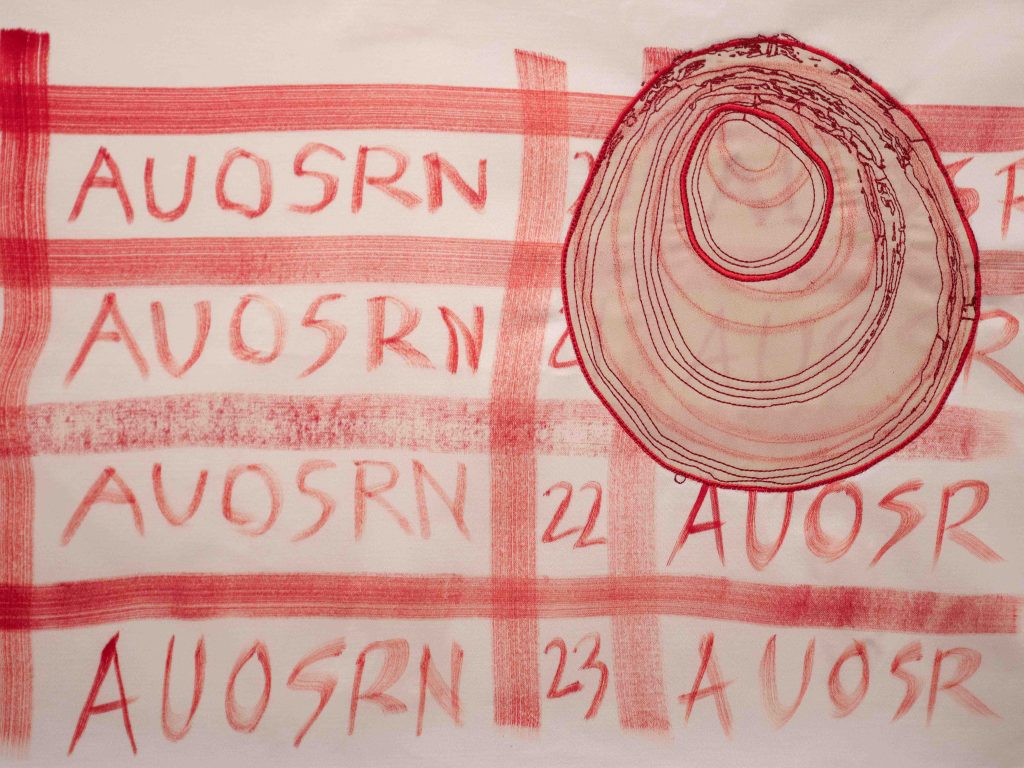
The image shows a grid drawn in bright blood red ink on pale cream silky fabric. The brush strokes from a wide stiff brush can be clearly seen in the lines of the grid. Inside the grid are letters and numbers drawn in a thinner brush that read AUOSRN and the numbers 22 and 23. On the top right hand side the grid is overlaid with an appliqué addition made from a darker cream translucent fabric. This has smudgy monoprint drawn and precisely stitched concentric circles in bright and deep red which break down and unravel at the top. It looks like an oyster or a finger print.
A grid drawn in bright blood red ink on pale cream silky fabric with numbers 22, 23 and letters: AUOSRN. On the top right hand side the grid is overlaid with an appliqué addition with monoprint drawn and precisely stitched concentric circles in bright and deep red which break down and unravel at the top.
The stitch time for the appliqué was around 22 minutes. Image: Josie Turnbull.

WELLBEING COACHING MODELS

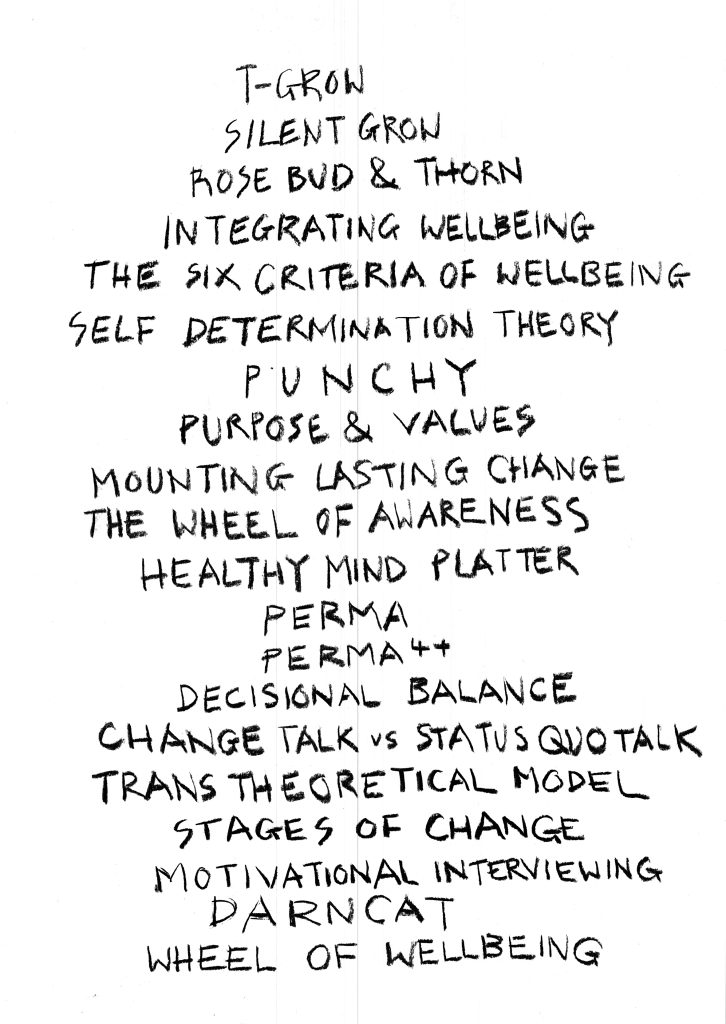
The image shows a hand written list of Wellbeing Coaching models and tools written in capital letters in black charcoal on a white background. The list from top to bottom reads: 
T-GROW 
Silent GROW 
Rose, Bud & Thorn 
Integrating Wellbeing
The Six Criteria of Well-Being 
Self-Determination Theory 
PUNCHY 
Purpose & Values 
Mounting Lasting Change 
The Wheel of Awareness 
Healthy Mind Platter
PERMA
PERMA⁴⁺ 
Decisional Balance 
Change Talk vs Status Quo Talk 
Transtheoretical Model 
Stages of Change 
Motivational Interviewing 
D.A.R.N.C.A.T. 
Wheel of Wellbeing

During the residency I am trying to finish an assessment for a wellbeing coaching course. This is a list of wellbeing coaching models and tools. It’s not, nor ever will be, exhaustive…

SPHERES OF INFLUENCE

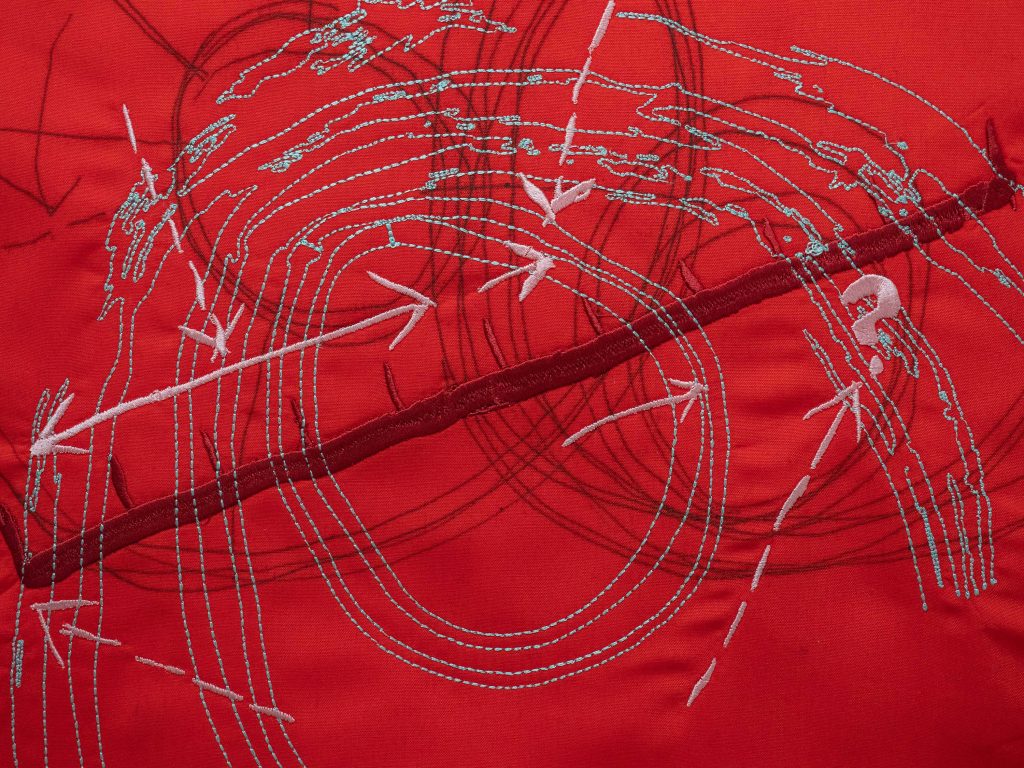
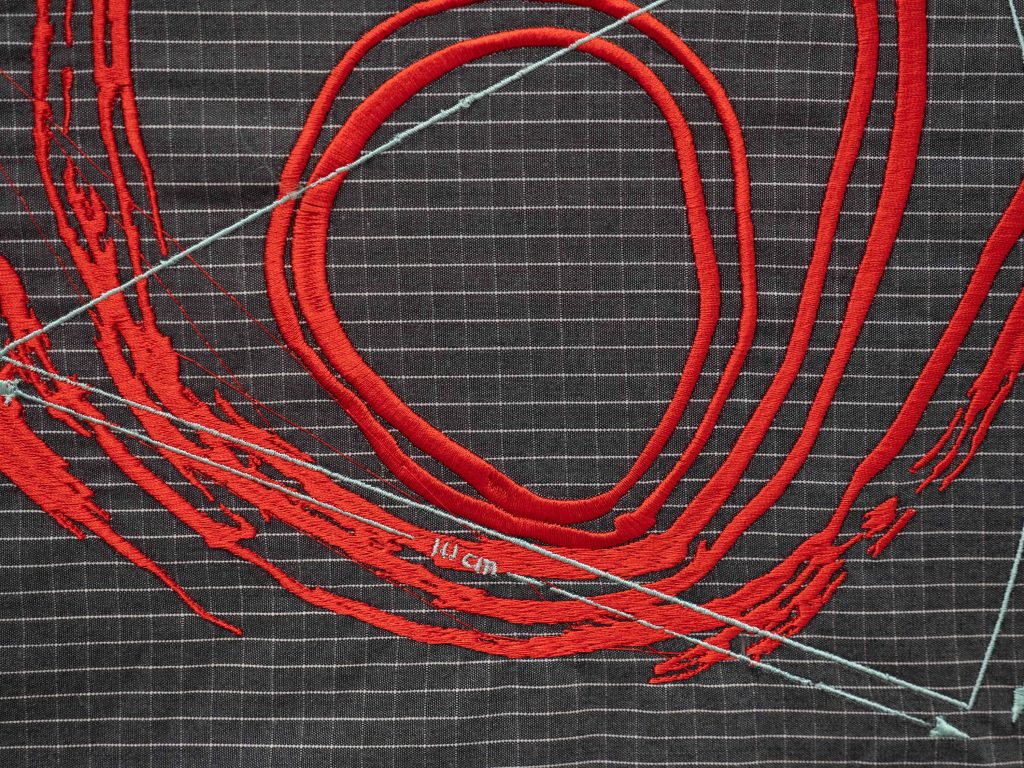
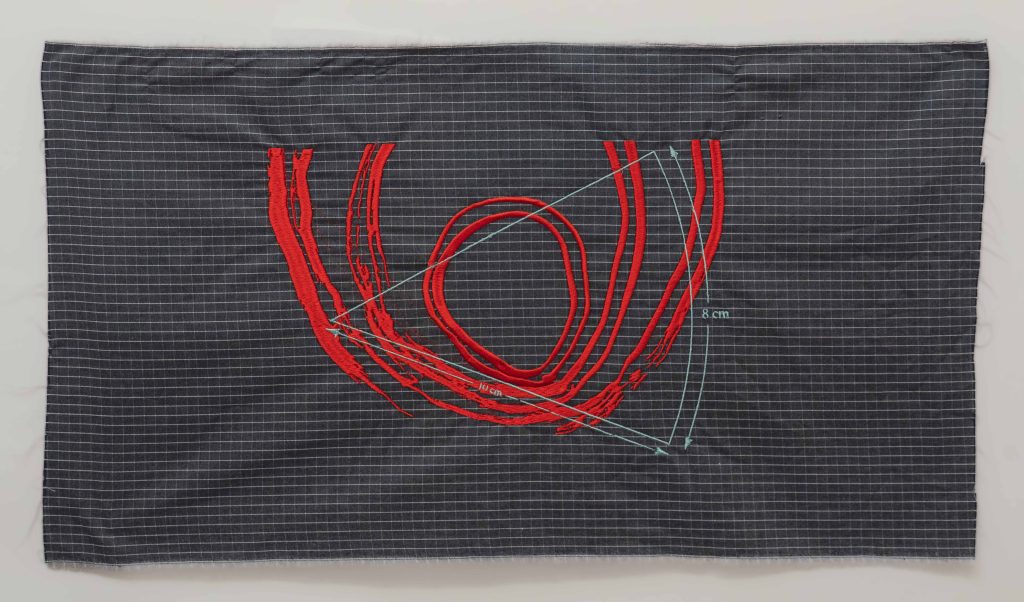
The image shows a photograph of machine embroidery on a densely checked polycotton fabric with a dark grey background and white lines. The embroidery is made up of thick bright red, ever increasing, yet disintegrating circles and half circles that resemble the inner world of an oyster or fingerprint stitched in silky satin thread. This contrasts with a geometric triangular shape with a measurement of 10cm stitched over the red circles in an eggshell blue thread.
Spheres of Influence (2026) detail. Image: Josie Turnbull.

I watch the recording of the residency induction, and I am struck by how generous the space is – a time to push back against the ‘should’ of productivity. It makes me think about my current work that I have been exploring during my DYCP which focuses on the opposite – on the ridicularity of healthcare and wellness processes based in efficiency and optimisation.

I also watch the recording of first meeting and then select these images of recent work-in-progress: a re-purposing of health and wellness mental and visualisation models and methods through drawing and embroidery. This sample was made with the help of Poppy Nash in April this year. It had a 77 minute stitch time. I feel it speaks to the meeting’s discussion on re-purposing, language and translation.

The image shows a photograph of machine embroidery on a densely checked unhemmed polycotton fabric with a dark grey background and white lines. The embroidery is made up of thick bright red, ever increasing, yet disintegrating circles and half circles that resemble the inner world of an oyster or fingerprint stitched in silky satin thread. This contrasts with a geometric triangular shape that resembles a line drawing of a slice of pie or cheese, with measurements of 10cm and 8cm stitched over the top of the red circles in an eggshell blue thread.
Spheres of Influence (2026) – digital embroidery from ink drawings of wellbeing coaching models and NHS food diary handout on cotton check fabric. Image: Josie Turnbull.

HOW TO START WITHOUT STARTING

I can’t be there for the first residency meeting. I talk to Jamie about how sad I am about this: that I can’t even meet the requirements of the residency from day one. We say of course that is ok, and I think about my studio text which says that I am embracing failure during this residency, but I still find it difficult to reconcile with the normative structures I have internalised.

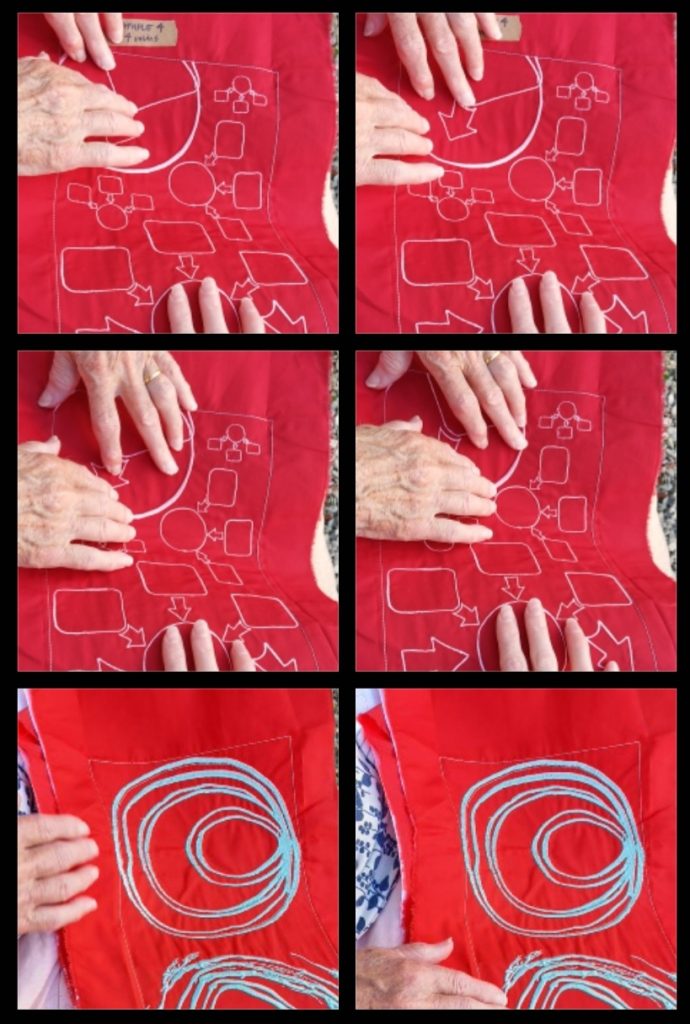
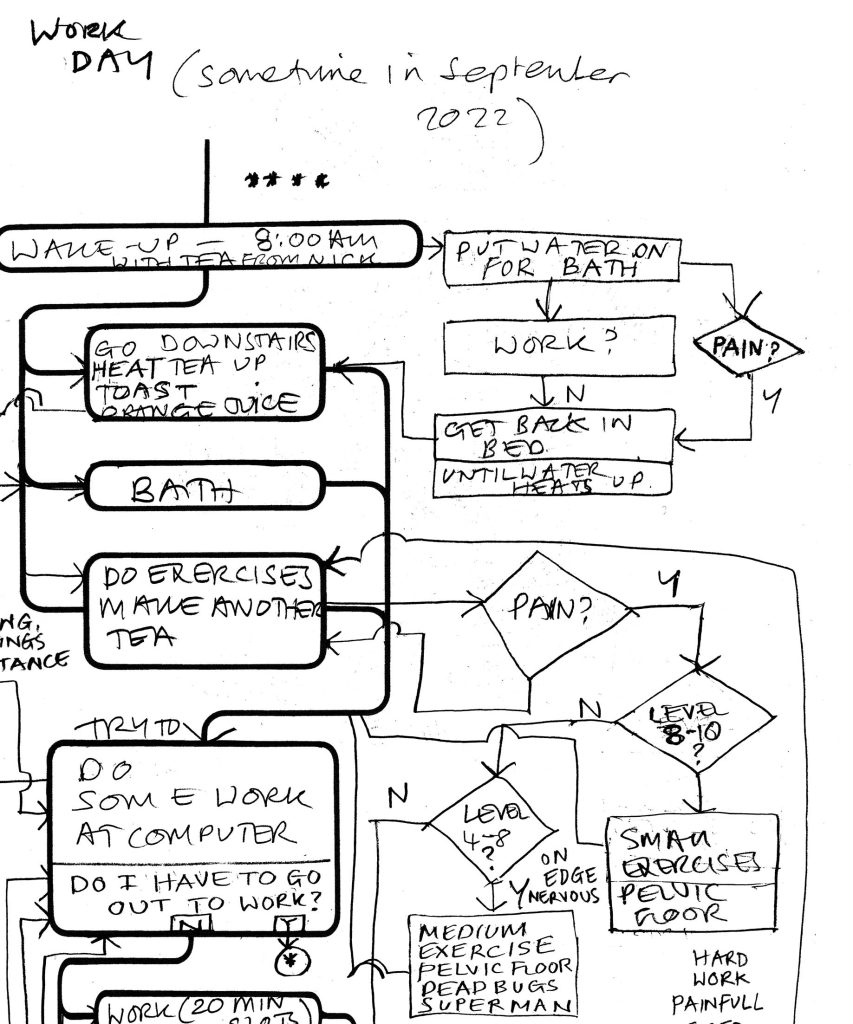
Section of a flowchart diagram in black hand written and printed text on a white background illustrating a daily routine on a workday in September 2022, focusing on managing pain and work activities throughout the day. Key decision points include pain levels, use of painkillers, exercise, work tasks, meals, and rest. Work tasks are organised in the centre, with labelled boxes and arrows spiralling around with multiple complex choices and actions.

(Un)productive Spatialisations #1 (detail) (2022)

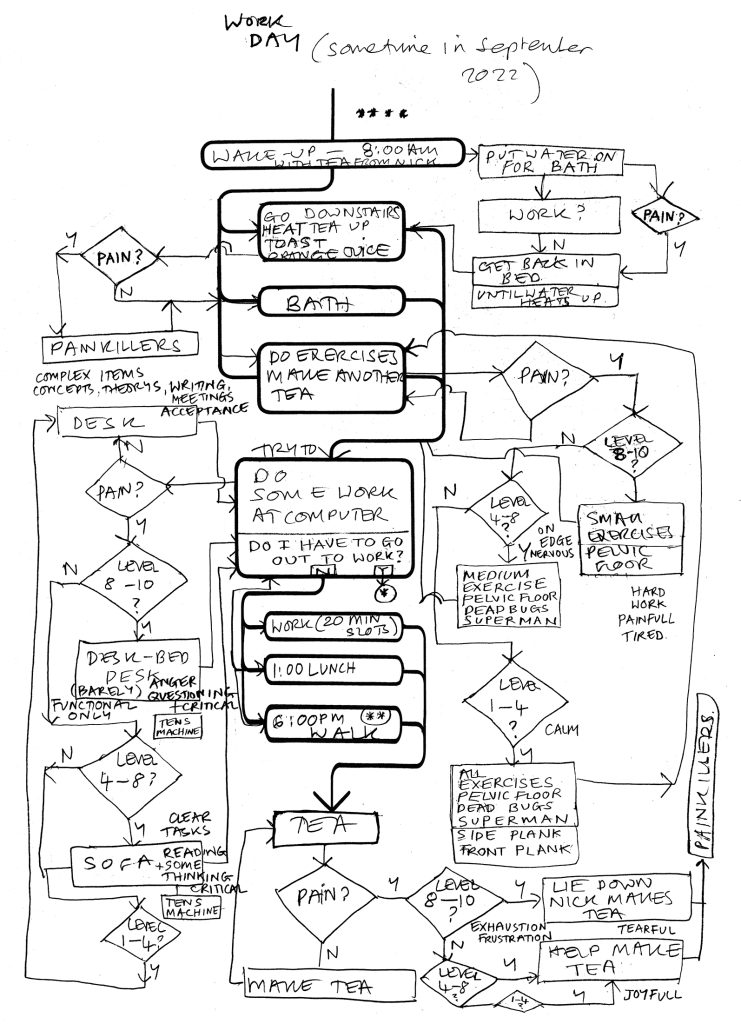
This situation makes me think about my drawing ‘(Un)Productive Spatialisations’ which I made in 2022 to highlight the work to get to make work. I am not in the same place as I was when I made this diagram, which tracks the granular choices a ‘sick’ bodymind makes to get to make work; to be in public, but it resonates with me now in a different way as I work with my sister to care for my mum. All the hidden labour that goes into living is in my mind and how this affects bodyminds in different ways – whether it’s the work of the ‘sick’ body, or the work to make work, or the work to care for someone else’s needs – all of which disproportionately affect those bodyminds whose needs aren’t seamlessly met by the environment around them.

Flowchart diagram in black hand written and printed text on a white background illustrating a daily routine on a workday in September 2022, focusing on managing pain and work activities throughout the day. Key decision points include pain levels, use of painkillers, exercise, work tasks, meals, and rest. Work tasks are organised in the centre, with labelled boxes and arrows spiralling around with multiple complex choices and actions.
(Un)productive Spatialisations #1 (2022)

I am grateful that Jamie says it’s fine that I can’t make it, and I viscerally relearn Alison Kafer’s critical aspect of crip time: that it’s more than fine to meet the day, the residency, the work as you are, rather than bend your body and mind to meet the clock, in fact, it’s fundamental.

I’ve included the audio description of the diagram by Char Heather as this is something I would like to explore more of during the residency. It’s an excerpt from a longer description which was written and recorded by Char for the project Public S/Pacing at Bloc Projects, Sheffield in 2024.