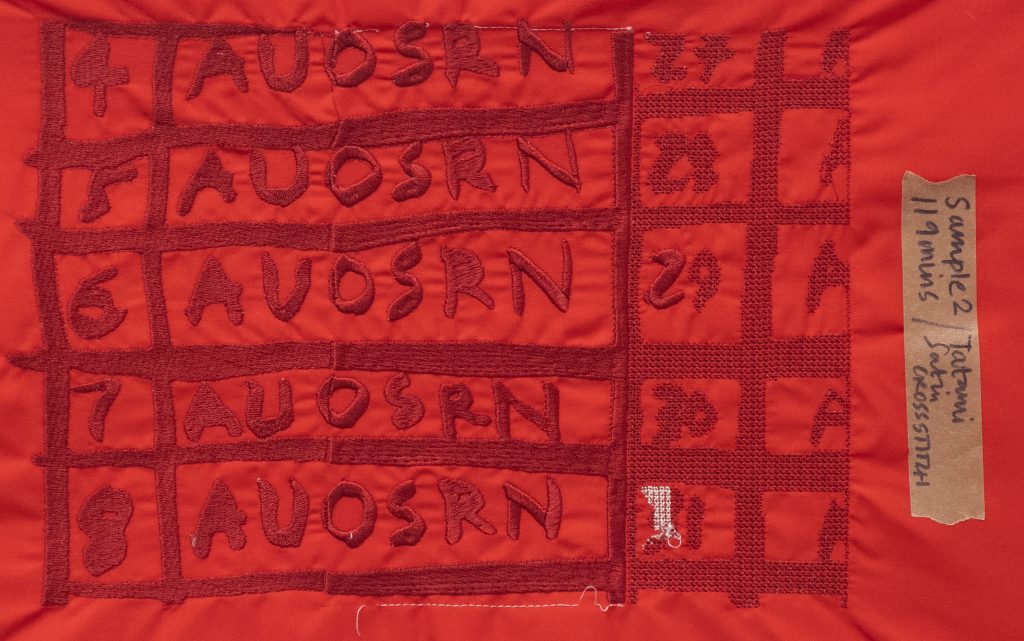
A photograph of deep dark red digital embroidery stitched onto a paler blood red fabric. The embroidery is in the form of a grid with numbers that run from top to bottom 4-8 and 27-31 consequentially and letters that read AUOSRN. The chart is cut off and in places the letters A are cut in half and in others red stitching is over sewn in white. On the right hand side a piece of brown tape with ripped edges has been stuck on the fabric. on the tape hand written text in black felt tip pen reads: Sample 2 119 mins / Tatami Satin CROSSSTITCH.
A photograph of deep dark red digital embroidery stitched onto a paler blood red fabric. Numbers run from top to bottom 4-8 and 27-31 and letters read AUOSRN. On the right hand side is a piece of brown tape with ripped edges stuck to the fabric. On the tape hand written text in black felt tip pen reads: Sample 2 119 mins / Tatami Satin CROSSSTITCH. Image: Josie Turnbull

I’ve been redrawing this mental health assessment chart for a while now. I have drawn it in charcoal, in watercolour, in ink, on fabric and translated it into digital embroidery. I am excited to explore where the material of the chart breaks down and fails, but also the performance-based repetitive action of filling in nonsensical questionnaires as an embodiment of crip time. I drew it recently on a whiteboard as part of a performative lecture at a the Society of Social History of Medicine conference at Leeds University with my co-conspirator 20th century healthcare historian Dr Caitjan Gainty. As I drew Caitjan talked about the histories of efficiency and productivity in spaces of work, medicine and healthcare…
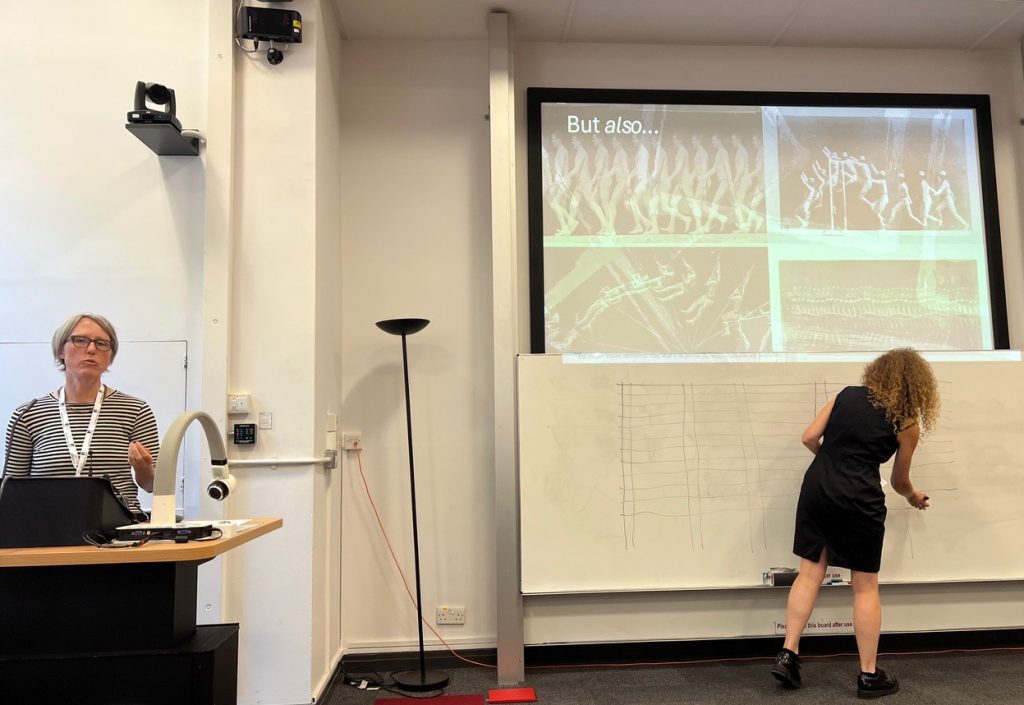
The photograph shows a view of the front of a typical lecture theatre or classroom. On the right a projection screen displays 19th-century motion-study photography and chronophotography illustrating human locomotion phases of upright male figures, notably featuring works by Eadweard Muybridge and Étienne-Jules Marey. These were the foundation of 'time and motion' studies by which awkward or redundant movements could be eliminated, tool layouts redesigns, fatigue reduced, and factory assembly-line efficiency maximised. 
Beneath the projected image is a whiteboard. A pale skinned woman in a black sleeveless knee height dress with red curly hair is drawing a chart on the whiteboard. She is leaning, a little awkwardly, to the right in order to bend to reach the extent of the board. On the left is a desk with a visualiser and lectern. A pale skinned grey haired woman with black rimmed glasses and a lanyard is speaking and making hand gestures to an invisible audience in front of the desk.
Caitjan Gainty (left) and Helen Stratford (right) presenting ‘The Ins and Outs of Productivity’
at SSHM 2026: In/Out University of Leeds July 2026: 20 minute paper and live drawing presentation.
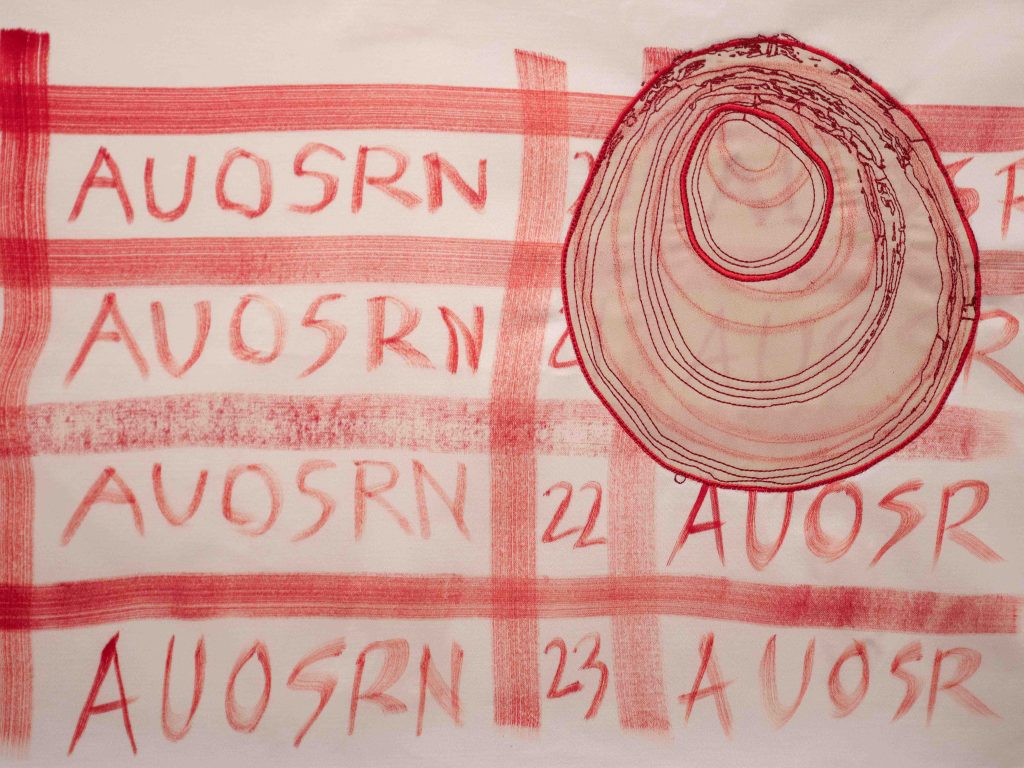
The image shows a grid drawn in bright blood red ink on pale cream silky fabric. The brush strokes from a wide stiff brush can be clearly seen in the lines of the grid. Inside the grid are letters and numbers drawn in a thinner brush that read AUOSRN and the numbers 22 and 23. On the top right hand side the grid is overlaid with an appliqué addition made from a darker cream translucent fabric. This has smudgy monoprint drawn and precisely stitched concentric circles in bright and deep red which break down and unravel at the top. It looks like an oyster or a finger print.
A grid drawn in bright blood red ink on pale cream silky fabric with numbers 22, 23 and letters: AUOSRN. On the top right hand side the grid is overlaid with an appliqué addition with monoprint drawn and precisely stitched concentric circles in bright and deep red which break down and unravel at the top.
The stitch time for the appliqué was around 22 minutes. Image: Josie Turnbull.

< Back